
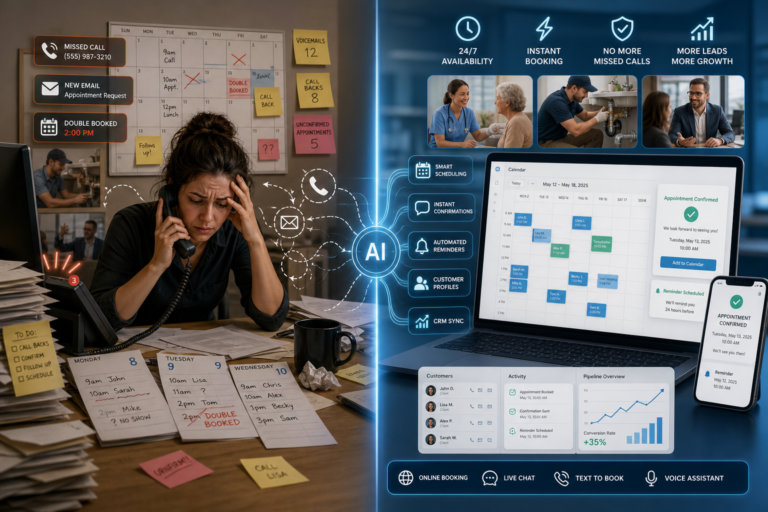

Businesses lose an average of 40% of potential appointments due to slow response times and scheduling friction. The difference between automated and manual scheduling can directly impact your revenue, customer satisfaction, and operational efficiency. This comparison breaks down how AI appointment booking systems stack up against traditional manual scheduling methods.
Manual scheduling remains common across service industries, but it creates bottlenecks that cost businesses both time and money. Understanding the operational differences between these approaches helps you make informed decisions about your booking infrastructure.
What Is Manual Appointment Scheduling
Manual scheduling requires human staff to coordinate appointments through phone calls, emails, text messages, or in-person interactions. A team member receives the inquiry, checks calendar availability, proposes times, confirms with the customer, and logs the appointment into a system.
This approach depends entirely on staff availability during business hours. When someone calls after hours or during peak times, they either reach voicemail or wait on hold. The back-and-forth communication to find a suitable time often spans multiple touchpoints across several days.
Manual processes also create data entry errors, double bookings, and missed follow-ups. Staff must remember to send reminders, handle cancellations, and update multiple systems manually. The administrative burden increases as appointment volume grows.
How AI Appointment Booking Systems Work
AI scheduling automation handles the entire booking workflow without human intervention. The system responds to inquiries instantly across channels like website chat, SMS, email, and social media. It checks real-time calendar availability, proposes suitable time slots, and confirms appointments immediately.
These intelligent scheduling systems qualify leads by asking relevant questions, collecting necessary information, and routing appointments to the appropriate team members. The AI booking system syncs with existing calendars, sends automated reminders, handles rescheduling requests, and updates your CRM automatically.
The technology operates 24/7 without breaks, sick days, or capacity limits. It maintains consistent communication quality and never forgets to follow up. When a customer expresses interest at midnight or during holidays, the system books them immediately instead of making them wait.
Speed to Booking Comparison
Manual scheduling typically takes 24 to 72 hours from initial inquiry to confirmed appointment. Customers must wait for staff availability, exchange multiple messages to coordinate timing, and often experience delays during busy periods. Research shows that 78% of customers book with the first business that responds.
AI booking workflows complete the same process in under two minutes. The system responds within seconds, presents available times immediately, and confirms the appointment on the spot. This speed advantage dramatically improves conversion rates and reduces the likelihood of customers exploring competitor options.
Speed matters because customer intent peaks at the moment of inquiry. Every hour of delay increases the chance they move on to another provider. Automated systems capture customers when motivation is highest, before doubt or alternative options enter their decision process.
Cost Analysis and Resource Allocation
Manual scheduling requires dedicated staff time. A receptionist spending four hours daily on appointment coordination represents significant fixed costs. For businesses handling 50+ bookings weekly, this can consume an entire full-time position at $35,000 to $50,000 annually when including benefits and overhead.
AI consultation scheduling eliminates these recurring labor costs. The technology operates at a fixed monthly subscription typically ranging from $200 to $800 depending on volume and features. The system handles unlimited inquiries without additional cost per booking.
Beyond direct savings, automation frees staff to focus on higher-value activities like customer service, sales closing, or service delivery. The productivity gain multiplies when you consider that automated systems never require training, sick leave, or replacement during turnover.
Availability and Customer Experience
Manual processes restrict booking to business hours, typically 9 AM to 5 PM on weekdays. Customers who think about scheduling during evenings, weekends, or holidays must wait. This creates friction and increases abandonment rates.
AI lead scheduling operates continuously without time restrictions. Customers book appointments whenever convenient for them, not when your office happens to be open. This flexibility aligns with modern customer expectations and removes a common barrier to conversion.
The experience also remains consistent. Manual scheduling quality varies based on staff training, experience, mood, and workload. Some customers receive friendly, efficient service while others encounter rushed or unhelpful interactions. Automation ensures every inquiry receives the same professional, prompt response.
Accuracy and Error Reduction
Human coordinators make mistakes. They double-book time slots, misrecord customer information, forget to send reminders, or fail to update calendars properly. These errors frustrate customers, create operational chaos, and damage your professional reputation.
Intelligent scheduling systems eliminate common booking errors through automated verification. The technology checks availability in real time before confirming appointments, validates contact information during collection, and ensures consistent data entry across integrated systems.
Automated reminders reduce no-show rates significantly. The system sends confirmation messages immediately after booking, reminder notifications 24 hours before the appointment, and follow-up communications if someone doesn’t arrive. This systematic approach cuts no-shows by 40% to 60% compared to manual reminder processes.
Scalability and Growth Management
Manual scheduling becomes increasingly difficult as your business grows. Handling 20 appointments weekly works fine with existing staff. Managing 100 weekly bookings requires dedicated coordinators. Scaling to 500 appointments demands multiple full-time scheduling staff and sophisticated coordination.
AI booking automation scales effortlessly. The system handles 10 or 1,000 monthly bookings with identical efficiency. There’s no need to hire additional staff, expand phone systems, or create complex scheduling departments. The technology adapts to volume fluctuations automatically.
This scalability proves especially valuable during growth phases, seasonal peaks, or marketing campaigns. When lead volume suddenly increases, automated systems absorb the additional inquiries without degraded response times or overwhelmed staff.
Integration and Workflow Efficiency
Manual processes often require staff to update multiple disconnected systems. They enter appointment details into a calendar, log customer information in the CRM, send confirmation emails manually, set personal reminders for follow-ups, and update spreadsheets for tracking.
AI sales automation platforms integrate directly with existing business systems. When someone books an appointment, the information flows automatically into your calendar, CRM, email marketing platform, and reporting dashboard. This eliminates duplicate data entry and ensures consistent information across tools.
The integration extends beyond booking. The system can trigger follow-up sequences, assign leads to team members based on criteria, update pipeline stages, and generate performance reports without manual intervention. This connected workflow reduces administrative overhead significantly.
Lead Qualification and Conversion Optimization
Manual scheduling often treats every inquiry the same way. Staff focus on finding an available time slot without thoroughly qualifying the lead or understanding their specific needs. This results in appointments with low-quality prospects while potentially rushing high-value opportunities.
AI lead scheduling can qualify prospects during the booking conversation. The system asks relevant questions to understand budget, timeline, project scope, and decision-making authority. It collects this information naturally while coordinating the appointment.
Qualified leads get routed to appropriate team members. High-value prospects might book with senior consultants, while basic inquiries connect with junior staff. This intelligent routing optimizes conversion rates and resource allocation simultaneously.
Multi-Channel Communication Management
Customers contact businesses through various channels including phone calls, website forms, SMS messages, Facebook messages, Instagram DMs, email, and live chat. Manual scheduling struggles to monitor and respond across all these touchpoints consistently.
AI booking workflows unify communication channels into a single interface. The system monitors all inquiry sources simultaneously and responds appropriately regardless of channel. Customers get consistent service whether they text, email, or message on social media.
This omnichannel capability prevents missed opportunities. When inquiries come through less-monitored channels like Instagram at odd hours, automated systems capture them immediately instead of discovering them days later when the opportunity has passed.
Data Collection and Business Intelligence
Manual scheduling provides limited insight into booking patterns, conversion rates, or customer behavior. Staff might remember that “Tuesdays seem busy” or “lots of people cancel,” but accurate data requires manual tracking and analysis.
Intelligent scheduling systems generate detailed analytics automatically. You see exactly how many inquiries convert to appointments, which time slots get booked most frequently, where leads originate, and how quickly appointments get confirmed. This data drives informed operational decisions.
The tracking extends to individual performance metrics. You can identify which team members maintain the highest show rates, which lead sources produce the best customers, and which booking patterns correlate with completed sales. These insights help optimize your entire sales process.
Customer Communication and Follow-Up
Manual processes depend on staff remembering to follow up. They might send a reminder the day before an appointment if they remember to check their task list. Follow-up after a missed appointment or completed consultation often gets forgotten during busy periods.
AI follow-up automation handles communication systematically. The system sends appointment confirmations immediately, reminder messages at scheduled intervals, and follow-up sequences after appointments. If someone misses their appointment, the system reaches out to reschedule automatically.
This consistent communication improves customer relationships and conversion rates. Prospects feel attended to throughout their journey, and businesses never lose opportunities due to forgotten follow-ups.
Implementation and Setup Requirements
Manual scheduling requires hiring and training staff, establishing scheduling procedures, creating scripts and workflows, and implementing quality control measures. New employees need weeks to become proficient at handling various scheduling scenarios and customer situations.
AI appointment booking platforms require initial configuration but become operational quickly. Setup involves connecting calendars, configuring availability rules, customizing conversation flows, and integrating existing systems. Most businesses complete implementation in days rather than weeks.
The ongoing management differs significantly too. Manual processes need continuous supervision, quality monitoring, and staff management. Automated systems require occasional workflow adjustments but largely run independently once configured properly.
Handling Complex Scheduling Scenarios
Manual scheduling excels at handling unusual or complex situations that require human judgment. When someone needs special accommodations, has complicated requirements, or presents unique circumstances, staff can adapt and problem-solve creatively.
Modern AI consultation scheduling has become sophisticated enough to handle many complex scenarios through conditional logic and decision trees. The system can manage different appointment types, varying durations, multiple locations, specific staff requirements, and custom booking rules.
For truly exceptional cases, hybrid approaches work well. The AI system handles standard bookings autonomously while routing complex situations to human staff for manual handling. This combines the efficiency of automation with the flexibility of human judgment.
Security and Data Privacy Considerations
Manual scheduling involves staff accessing sensitive customer information including contact details, health information for medical practices, financial data for consulting, and personal circumstances. This creates data privacy risks and requires extensive staff training on compliance requirements.
AI booking systems built for enterprise use include robust security measures. Data gets encrypted in transit and at rest, access controls limit who sees sensitive information, and compliance features support HIPAA, GDPR, and other regulatory requirements. The technology maintains detailed audit logs of all data access.
Automated systems also reduce the number of people handling sensitive information. Instead of multiple staff members seeing customer details during the scheduling process, the information gets securely stored and accessed only when necessary.
ROI and Business Impact Measurement
Calculating the return on investment for manual scheduling proves difficult because costs hide in staff time, missed opportunities, and operational inefficiencies. Businesses rarely track how many potential customers abandon the booking process or choose competitors due to slow response times.
AI scheduling automation provides clear ROI metrics. You can measure the increase in booking conversion rates, reduction in staff time spent on coordination, decrease in no-show rates, and growth in after-hours bookings. Most businesses see positive ROI within three to six months.
The business impact extends beyond direct cost savings. Faster response times improve customer satisfaction scores, consistent communication enhances brand perception, and freed staff time enables better service delivery. These factors contribute to long-term business growth and competitive advantage.
Common Implementation Challenges
Businesses transitioning from manual to automated scheduling often worry about losing the personal touch or encountering technical problems. Staff may resist change, particularly if they fear technology replacing their roles. These concerns require thoughtful change management.
Successful implementation focuses on positioning automation as a tool that enhances rather than replaces human work. Staff shift from administrative coordination to relationship building and complex problem-solving. The technology handles repetitive tasks while people focus on activities requiring empathy, creativity, and judgment.
Technical challenges typically involve integration with existing systems and workflow customization. Working with platforms that offer implementation support and have experience in your industry reduces these obstacles significantly. Most integration issues get resolved during the setup phase.
Industry-Specific Considerations
Different industries have unique scheduling requirements. Medical practices need insurance verification and HIPAA compliance. Home service businesses require service area checking and job estimation. Professional services often need discovery calls before booking consultations.
AI booking workflows can be customized for industry-specific needs. The system adapts conversation flows, qualification questions, and booking rules to match your business model. This flexibility makes automation viable across diverse service industries.
Businesses should evaluate automation platforms based on industry experience and customization capabilities. Generic scheduling tools often lack the specific features needed for specialized industries, while purpose-built solutions include relevant functionality out of the box.
Making the Transition Decision
Choosing between manual and automated scheduling depends on your current appointment volume, growth goals, staff capacity, and customer expectations. Businesses handling fewer than 20 monthly appointments might function adequately with manual processes, though they still miss after-hours opportunities.
Companies booking 50+ appointments monthly almost always benefit from automation. The time savings, conversion improvements, and error reduction provide clear value that outweighs implementation costs. The decision becomes even more compelling for businesses in growth mode or facing staffing challenges.
Consider starting with a hybrid approach if fully automated booking feels overwhelming. Let the AI system handle initial inquiry response and appointment coordination while staff manages follow-ups and complex situations. You can expand automation as comfort and confidence grow.
Future of Appointment Scheduling Technology
Scheduling automation continues advancing rapidly. Current systems already handle natural conversation, qualify leads, and manage complex booking scenarios. Future developments will bring more sophisticated personalization, predictive scheduling based on customer behavior, and deeper integration with business intelligence platforms.
Voice-based booking through phone calls is improving quickly. Soon, customers won’t distinguish between talking to an AI system and a human coordinator. The technology will handle phone inquiries with the same efficiency it currently manages text-based conversations.
The competitive landscape will increasingly favor businesses using intelligent scheduling systems. As customer expectations for instant response and 24/7 availability become standard, companies relying on manual processes will struggle to compete effectively.
Frequently Asked Questions
How long does it take to implement AI appointment booking?
Most businesses complete implementation in 3 to 7 days. Initial setup involves connecting calendars, configuring availability rules, and customizing conversation flows. Simple implementations with standard requirements can go live in 48 hours. Complex setups requiring extensive customization or multiple integrations may take two weeks. The platform typically handles basic bookings immediately while you refine advanced features over time.
Can AI scheduling handle last-minute changes and cancellations?
Yes, intelligent scheduling systems manage appointment changes automatically. Customers can reschedule or cancel through the same channels they used for booking. The system updates calendars in real time, sends updated confirmations, and reopens the time slot for other bookings. It can also automatically offer alternative times when someone cancels, attempting to keep them scheduled rather than losing the appointment entirely.
What happens if the AI system encounters a question it cannot answer?
Modern AI booking platforms include escalation protocols for complex situations. When the system cannot handle a specific request, it smoothly transfers the conversation to human staff or schedules a call back during business hours. The customer receives acknowledgment that their special requirement was noted. Most platforms allow you to configure which scenarios trigger human escalation based on your business needs.
How much does AI appointment booking cost compared to manual scheduling?
AI scheduling platforms typically cost $200 to $800 monthly depending on features and appointment volume. Manual scheduling using dedicated staff costs $35,000 to $50,000 annually per full-time coordinator. For businesses handling 50+ appointments weekly, automation provides 80% to 90% cost reduction while improving response times and conversion rates. The ROI usually becomes positive within three to six months.
Will customers know they are interacting with AI?
This depends on your preference and industry regulations. Some businesses disclose AI involvement upfront, while others let the natural conversation flow without explicit mention. The technology has advanced to the point where most customers cannot distinguish automated responses from human coordination. What matters most is that the system provides quick, accurate, and helpful service regardless of whether customers realize AI powers the interaction.
Can AI booking systems integrate with my existing calendar and CRM?
Most enterprise-grade AI scheduling platforms integrate with popular calendars like Google Calendar, Outlook, and Apple Calendar. They also connect with major CRM systems including Salesforce, HubSpot, and Zoho. Custom integrations are often available for proprietary systems through APIs. The features typically include two-way sync, ensuring that appointments booked through any channel appear everywhere and calendar blocks prevent double-booking.
How does automated scheduling improve conversion rates?
AI systems improve conversion rates through several mechanisms. Instant response captures customers when interest peaks, 24/7 availability removes timing barriers, consistent communication prevents confusion, automated follow-ups reduce abandonment, and friction-free booking makes scheduling easy. Businesses typically see 30% to 60% improvement in inquiry-to-appointment conversion after implementing intelligent scheduling systems. The exact improvement depends on previous manual process efficiency.
What industries benefit most from AI appointment booking?
Service-based businesses with high appointment volumes benefit significantly. This includes medical and dental practices, home services like HVAC and roofing, real estate professionals, legal consultations, automotive services, wellness and med spas, and professional consulting. Any business where the initial customer interaction involves scheduling an appointment or consultation sees value from automation. Industry-specific customization ensures the system handles unique requirements effectively.
Take Control of Your Booking Process
The difference between manual scheduling and AI automation extends far beyond simple efficiency gains. Automated systems transform how customers experience your business, how staff spend their time, and how reliably you convert inquiries into revenue.
Businesses still using manual processes face increasing competitive disadvantage as customer expectations evolve. The companies responding instantly, operating 24/7, and providing friction-free booking will capture market share from those making customers wait.
Evaluate your current scheduling performance honestly. Calculate how many inquiries you receive after hours, how long responses take during busy periods, and what percentage of initial contacts convert to booked appointments. These metrics reveal whether your current approach supports or limits your growth.
Ready to see how AI scheduling automation can transform your booking process? Explore GetDMFlow’s features or book a demo to see the platform in action. The investment in intelligent scheduling systems pays for itself quickly through improved conversion rates, reduced administrative costs, and better customer experiences that drive long-term business growth.
