
Customer acquisition is the backbone of any growing business. But most service companies still rely on manual processes that create delays, missed leads, and inconsistent follow-up. AI changes that by automating the entire customer acquisition workflow from first contact to booked appointment.
When you automate your customer acquisition with intelligent systems, you respond faster, engage more consistently, and convert more leads without adding headcount. This is not about replacing your team. It’s about giving them the infrastructure to close more deals with less friction.
What Is AI Customer Acquisition Automation
AI customer acquisition automation uses intelligent systems to handle repetitive tasks across your sales funnel. These systems qualify leads, send personalized messages, book appointments, and follow up based on behavior and intent.
The goal is simple: move prospects through your pipeline faster while maintaining quality engagement. Instead of waiting hours for a salesperson to respond, AI systems can engage leads in seconds. Instead of manually sending follow-up emails, AI workflows trigger based on user actions.
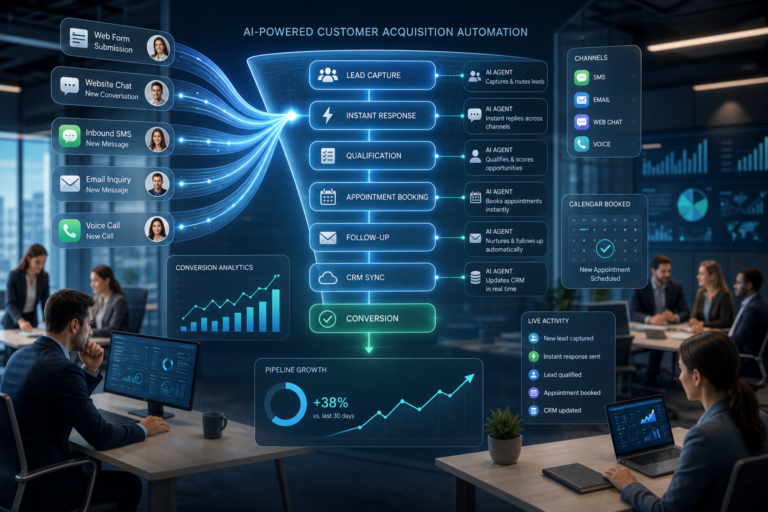
This is not generic chatbot technology. Modern AI sales funnel automation platforms like GetDMFlow are built to manage entire customer journeys across SMS, email, web chat, and voice channels. They integrate with your CRM, track conversion metrics, and optimize engagement over time.
Why Traditional Customer Acquisition Workflows Fail
Most service businesses lose leads because their acquisition process is too slow or inconsistent. A lead fills out a form on your website at 9 PM. Your team sees it the next morning. By then, the lead has already contacted three competitors.
Manual workflows also create bottlenecks. Sales reps spend hours on low-value tasks like data entry, scheduling, and sending reminder emails. High-intent leads get the same treatment as tire kickers. Follow-up becomes sporadic, and opportunities fall through the cracks.
AI solves these problems by automating the repetitive parts of customer acquisition while letting your team focus on closing deals. You get speed, consistency, and scalability without sacrificing personalization.
How AI Transforms Every Stage of Customer Acquisition
Customer acquisition is not a single event. It’s a multi-stage process that requires coordination across lead capture, qualification, engagement, nurturing, and conversion. AI improves each stage by removing manual friction and optimizing decision-making.
Lead Capture and Instant Response
The first interaction sets the tone for the entire relationship. When a lead reaches out, they expect a fast response. Studies show that responding within five minutes increases conversion rates by up to 400%.
AI lead response automation ensures every lead gets an immediate reply, no matter when they contact you. The system acknowledges their inquiry, asks qualifying questions, and routes high-intent leads to your sales team.
This instant engagement keeps prospects warm and prevents them from moving on to competitors. It also filters out unqualified leads early, so your team only spends time on opportunities worth pursuing.
Lead Qualification and Segmentation
Not all leads are created equal. Some are ready to buy. Others are just researching. AI qualification workflows ask the right questions to determine intent, budget, timeline, and fit.
Based on the answers, leads are automatically segmented into different nurture tracks. High-intent leads get routed to sales immediately. Mid-funnel leads enter a AI lead nurturing systems sequence. Low-intent leads get educational content until they’re ready to engage.
This segmentation ensures that every lead receives the right message at the right time. Your team stops wasting time on unqualified prospects, and your conversion rates improve because you’re focusing energy where it matters.
Appointment Booking Without the Back-and-Forth
Scheduling calls and consultations is one of the biggest time sinks in customer acquisition. The typical process involves multiple emails, calendar conflicts, and missed appointments.
AI appointment booking automation eliminates this friction. The system offers available time slots based on your calendar, confirms the appointment, and sends reminders leading up to the meeting.
If a prospect needs to reschedule, the AI handles it automatically. This reduces no-shows, increases booking rates, and frees up your team to prepare for conversations instead of coordinating logistics.
Continuous Follow-Up and Engagement
Most deals are lost because of inconsistent follow-up. A lead expresses interest, but no one checks in. They go cold, and the opportunity disappears.
AI follow-up automation solves this by maintaining contact over time. The system sends personalized messages based on lead behavior, engagement level, and funnel stage. If a lead opens an email but doesn’t respond, the AI follows up with a different angle.
This continuous engagement keeps your brand top of mind without overwhelming prospects. The AI knows when to push and when to back off, creating a natural conversation flow that feels human, not robotic.
Conversion Optimization Through Data
AI systems don’t just automate tasks. They learn from every interaction. Over time, the platform identifies which messages get the best response rates, which questions qualify leads most effectively, and which follow-up sequences drive the most conversions.
This data feeds back into your AI lead conversion automation workflows, making them smarter with every cycle. You’re not guessing what works. You’re optimizing based on real performance metrics.
Key Benefits of AI-Powered Customer Acquisition

Automating your customer acquisition workflows delivers measurable business outcomes. These benefits compound over time as your systems get smarter and your team becomes more efficient.
Faster Response Times
Speed is the single biggest factor in lead conversion. AI systems respond to inbound leads in seconds, not hours. This immediacy increases engagement rates and prevents prospects from contacting competitors.
When leads get instant answers to their questions, they feel valued. That positive first impression carries through the entire sales process and increases the likelihood of closing the deal.
Higher Conversion Rates
AI improves conversion by ensuring no lead falls through the cracks. Every inquiry gets a response. Every qualified lead gets nurtured. Every high-intent prospect gets routed to sales at the right moment.
By removing delays and inconsistencies from your funnel, you turn more inquiries into booked appointments and more appointments into closed deals. The result is a higher return on every marketing dollar you spend.
Better Lead Qualification
Manual qualification is subjective and time-consuming. AI qualification workflows use consistent criteria to evaluate every lead. This removes bias, speeds up the process, and ensures your team only spends time on opportunities with real potential.
Better qualification also improves team morale. Sales reps stop chasing dead ends and start closing deals with prospects who are ready to buy.
Scalability Without Added Headcount
As your business grows, your lead volume increases. Hiring more salespeople to handle the influx is expensive and slow. AI sales automation scales instantly. Whether you get 10 leads a day or 1,000, the system handles them all with the same speed and consistency.
This scalability lets you grow revenue without proportionally increasing overhead. You can take on more leads, expand into new markets, and test new acquisition channels without worrying about capacity constraints.
Improved Customer Experience
AI-powered acquisition workflows create a smoother, more responsive experience for prospects. They get fast answers, personalized communication, and convenient scheduling options. This reduces friction and builds trust before they even speak to a salesperson.
A better customer experience leads to higher satisfaction, more referrals, and stronger long-term relationships. You’re not just closing more deals. You’re building a foundation for sustainable growth.
How Different Industries Use AI for Customer Acquisition
AI customer acquisition workflows are not one-size-fits-all. Different industries have unique challenges, lead sources, and sales cycles. Here’s how service businesses across sectors apply these systems.
Home Services and Contractors
Roofing companies, HVAC contractors, and solar installers rely on inbound leads from paid ads, SEO, and referrals. These leads often reach out with urgent needs, and speed matters.
AI systems capture leads from web forms, SMS, and phone calls, then immediately engage with qualifying questions. High-intent leads get booked for inspections or consultations within minutes. Lower-intent leads enter nurture sequences until they’re ready to move forward.
This automation helps home service businesses respond faster than competitors and convert more estimates into booked jobs.
Real Estate Professionals
Real estate agents juggle dozens of leads at different stages of the buying or selling process. AI helps by automating initial outreach, scheduling property tours, and sending follow-up messages based on buyer behavior.
When a prospect views a listing online, the AI can send details about similar properties, answer common questions, and offer to book a showing. This keeps leads engaged and reduces the time agents spend on administrative tasks.
Healthcare and Wellness
Dentists, med spas, and specialty clinics use AI to automate appointment booking, send treatment reminders, and nurture patients through long decision cycles. For elective procedures, the AI educates prospects with informational content while maintaining contact until they’re ready to book.
This approach improves patient acquisition while ensuring the front desk team can focus on in-person care rather than phone tag.
Legal and Professional Services
Law firms and consultants often deal with high-value, high-consideration clients. AI qualification workflows filter serious inquiries from casual browsers, ensuring attorneys and consultants spend time on cases that match their expertise and fee structure.
The system also automates intake processes, collects case details, and schedules consultations, making it easier for prospects to engage without navigating complex phone trees or waiting for callbacks.
Building an AI Customer Acquisition System

Implementing AI customer acquisition automation requires strategic planning and the right technology stack. Here’s how to build a system that drives results.
Define Your Acquisition Funnel
Start by mapping your current customer acquisition process. Identify every touchpoint from initial contact to closed deal. Where do leads come from? What questions do they ask? What causes deals to stall?
This mapping reveals bottlenecks and opportunities for automation. You’ll see where manual tasks slow things down and where inconsistent follow-up causes drop-off.
Choose the Right Automation Platform
Not all AI platforms are built the same. Look for systems that offer multi-channel communication, CRM integration, and intelligent workflow automation. Avoid platforms that only offer basic chatbots or simple email sequences.
GetDMFlow is designed specifically for service businesses that need AI customer communication automation across the entire funnel. The platform handles lead capture, qualification, appointment booking, follow-up, and CRM sync in one unified system.
Set Up Lead Capture Channels
Integrate your AI system with every lead source. This includes your website, landing pages, social media ads, phone lines, and email. When a lead comes in from any channel, the AI should capture their information and begin engagement immediately.
Most platforms offer native integrations with popular tools like Google Ads, Facebook Lead Ads, and Zapier. This makes setup faster and ensures no leads slip through the cracks.
Create Qualification Workflows
Build question sets that help the AI determine lead quality. These questions should be conversational, not interrogative. Ask about their needs, timeline, budget, and decision-making process in a way that feels natural.
Based on their answers, assign lead scores and route them to the appropriate next step. High-scoring leads go straight to your sales team. Medium-scoring leads enter nurture tracks. Low-scoring leads get educational content.
Design Nurture Sequences
Not every lead is ready to buy today. Create nurture sequences that provide value over time. Share case studies, answer common questions, and address objections through automated messages.
These sequences should feel personal, not generic. Use the information you’ve collected about each lead to tailor the content. A lead interested in pricing should get different messages than one still researching solutions.
Integrate With Your CRM
AI CRM automation ensures all lead data, interactions, and status updates sync automatically. Your sales team should see a complete history of every conversation without switching between platforms.
This integration eliminates data entry, reduces errors, and gives your team full visibility into where each lead stands in the funnel.
Monitor and Optimize Performance
Once your system is live, track key metrics like response time, qualification rate, appointment booking rate, and conversion rate. Use this data to identify weak points and test improvements.
AI systems get better over time as they learn from interactions. Review performance monthly and adjust messaging, qualification criteria, and routing rules based on what the data shows.
Common Mistakes to Avoid
Even the best AI systems fail if they’re implemented poorly. Here are common mistakes that undermine customer acquisition automation.
Over-Automating the Human Touch
Automation should enhance your sales process, not replace genuine human connection. Use AI for repetitive tasks like scheduling and follow-up, but let your team handle high-stakes conversations and relationship building.
If prospects feel like they’re talking to a robot, they’ll disengage. Balance efficiency with empathy.
Ignoring Lead Quality
Automating everything without proper qualification leads to wasted time. Your sales team will get flooded with low-quality leads, and conversion rates will suffer.
Invest time upfront to build smart qualification workflows. It’s better to route fewer, higher-quality leads than to overwhelm your team with noise.
Using Generic Messaging
AI systems can personalize at scale, but only if you give them the right inputs. Avoid sending the same message to every lead. Use data about their industry, needs, and behavior to customize communication.
Personalization increases engagement and shows prospects that you understand their specific situation.
Failing to Train Your Team
Your sales team needs to understand how the AI system works and how to leverage it effectively. Provide training on reading AI-generated lead scores, following up on qualified leads, and using CRM data.
When your team trusts the system and knows how to use it, adoption improves and results follow.
Not Testing and Iterating
AI customer acquisition is not a set-it-and-forget-it solution. Markets change, customer preferences shift, and messaging wears out. Regularly test different approaches and refine your workflows based on performance.
Companies that continuously optimize their systems see compounding improvements over time.
Measuring the ROI of AI Customer Acquisition

To justify investment in AI automation, you need to track measurable outcomes. Here are the key metrics that show whether your system is working.
Lead Response Time
Measure how quickly your AI system responds to inbound leads. Best-in-class systems respond in under 60 seconds. Compare this to your previous manual response times to see the improvement.
Faster response times directly correlate with higher conversion rates, making this one of the most important early indicators of success.
Lead-to-Appointment Conversion Rate
Track how many leads book appointments through your automated system versus your old process. AI appointment booking should increase this rate by reducing friction and offering convenient scheduling options.
Appointment Show Rate
Automated reminders and confirmations should reduce no-shows. Measure your show rate before and after implementing AI follow-up workflows. Even a 10% improvement here can have a significant impact on revenue.
Cost Per Acquired Customer
Calculate how much you spend on marketing and sales to acquire each new customer. AI should lower this cost by improving conversion efficiency and reducing the need for additional sales headcount.
Sales Cycle Length
Measure how long it takes to move a lead from first contact to closed deal. AI automation should shorten the sales cycle by eliminating delays and keeping prospects engaged throughout the journey.
Revenue Per Lead
As your conversion rates improve and your sales cycle shortens, the revenue you generate from each lead should increase. This is the ultimate measure of AI customer acquisition success.
FAQ
What is AI customer acquisition automation?
AI customer acquisition automation uses intelligent systems to handle repetitive sales tasks like lead response, qualification, appointment booking, and follow-up. These systems engage prospects instantly, segment them based on intent, and move them through your pipeline without manual intervention.
How does AI improve lead response time?
AI systems respond to inbound leads in seconds by automatically sending personalized messages, asking qualifying questions, and routing high-intent prospects to sales. This eliminates the delays caused by manual processes and increases the likelihood of conversion.
Can AI replace my sales team?
No. AI handles repetitive tasks so your sales team can focus on building relationships and closing deals. The goal is to automate low-value activities, not replace human expertise. Your team becomes more efficient and effective with AI support.
What types of businesses benefit from AI customer acquisition?
Service-based businesses like home services, real estate, healthcare, legal, and professional services see the biggest gains. Any business with high lead volume, multi-step sales processes, or long follow-up cycles benefits from automation.
How long does it take to implement AI customer acquisition automation?
Implementation timelines vary based on complexity, but most businesses can launch core workflows within 2-4 weeks. This includes lead capture setup, qualification logic, appointment booking, and CRM integration. Optimization is ongoing as you refine messaging and workflows.
Does AI work across multiple communication channels?
Yes. Modern AI platforms like GetDMFlow support SMS, email, web chat, and voice. This multi-channel approach meets prospects where they are and maintains consistent engagement across all touchpoints.
How do I measure the success of AI customer acquisition?
Track metrics like lead response time, lead-to-appointment conversion rate, appointment show rate, cost per acquisition, sales cycle length, and revenue per lead. These metrics show whether your automation is driving real business outcomes.
What’s the difference between AI chatbots and AI customer acquisition systems?
Chatbots typically handle basic questions on your website. AI customer acquisition systems manage the entire funnel from lead capture to conversion across multiple channels. They integrate with your CRM, automate follow-up, book appointments, and optimize over time based on performance data.
How much does AI customer acquisition automation cost?
Pricing varies by platform and feature set. Most solutions charge based on lead volume, number of users, or conversations handled. GetDMFlow offers transparent pricing designed for service businesses of all sizes. Visit the pricing page for details.
Can I customize AI workflows for my specific business?
Yes. The best AI platforms offer flexible workflow builders that let you customize qualification questions, messaging, routing rules, and follow-up sequences. This ensures the automation aligns with your unique sales process and customer journey.
Start Automating Customer Acquisition Today
Manual customer acquisition workflows create bottlenecks, slow response times, and missed opportunities. AI automation removes these friction points by handling repetitive tasks, engaging leads instantly, and optimizing conversion at every stage.
When you implement automated customer journeys, you respond faster, qualify better, and convert more leads without adding headcount. Your team focuses on high-value activities while AI handles the rest.
GetDMFlow provides the infrastructure service businesses need to scale customer acquisition efficiently. From lead capture to appointment booking to continuous follow-up, the platform automates your entire funnel while maintaining the personalization your prospects expect.
Ready to see how AI can transform your customer acquisition process? Book a demo and discover how GetDMFlow helps businesses like yours convert more leads, book more appointments, and grow revenue faster.
