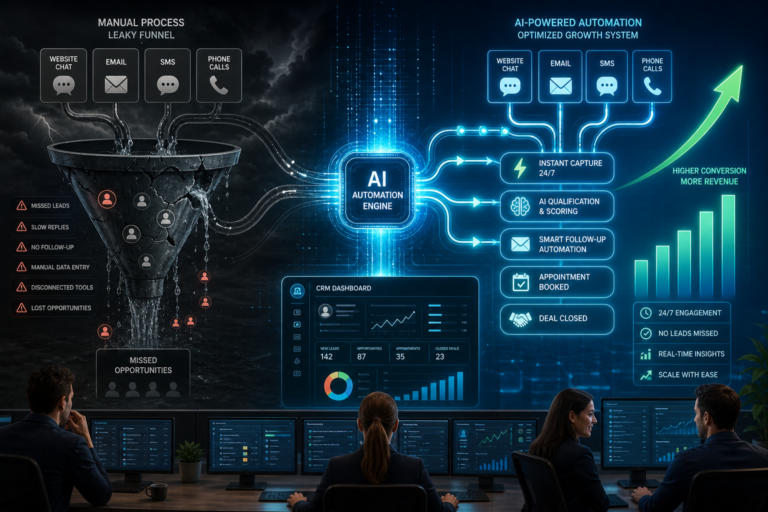

Service businesses lose revenue every day because their sales funnels leak leads. Prospects contact them, show interest, and then disappear before converting. The reason isn’t lack of demand. It’s operational inefficiency in how businesses manage customer journeys from first contact to closed sale. AI funnel automation solves this by creating intelligent, self-optimizing workflows that guide prospects through each stage without manual intervention.
Traditional sales funnels require constant human oversight. Someone has to respond to inquiries, send follow-ups, qualify leads, book appointments, and nurture prospects through multiple touchpoints. When volume increases, teams fall behind. Response times slow down, follow-ups get missed, and qualified leads slip through gaps in the process. AI sales funnel automation addresses this by building conversion infrastructure that operates 24/7 with consistent quality across every customer interaction.
What AI Funnel Automation Actually Does
AI funnel automation replaces manual sales tasks with intelligent workflows that execute automatically based on prospect behavior. When a lead enters your funnel through a form submission, phone call, or website chat, the system immediately responds, qualifies the prospect, and moves them to the appropriate next step. This happens instantly, regardless of time of day or current team capacity.
The automation handles lead response within seconds, not hours. It asks qualifying questions through conversational interfaces, identifies high-intent prospects, and routes them to booking workflows or sales teams based on predefined criteria. Lower-intent leads enter nurture sequences that educate and build trust over time. Every interaction is logged, tracked, and used to optimize future engagements.
The Operational Problems Manual Funnels Create
Manual sales funnels create predictable bottlenecks. Response delays cause 78% of leads to choose the first business that replies. When your team takes hours to respond, competitors who reply faster win the sale. This isn’t a service quality issue. It’s a structural problem that automation solves.
Follow-up consistency breaks down under volume. Sales teams intend to send multiple touchpoints, but daily urgencies interrupt planned sequences. Prospects who need seven to ten interactions before buying get abandoned after two or three attempts. GetDMFlow’s AI follow-up automation ensures every lead receives the complete nurture sequence regardless of team bandwidth.
Qualification becomes inconsistent when different team members ask different questions or interpret answers subjectively. One salesperson might classify a prospect as high-priority while another rates them low-value based on the same information. Automated qualification applies uniform criteria across every conversation, creating predictable pipeline quality.
How AI Creates Self-Optimizing Customer Journeys
Intelligent funnel systems learn from conversion data. When certain message sequences produce higher booking rates, the system identifies those patterns and applies them to similar prospects. When specific qualification questions better predict purchase intent, those questions get prioritized in future conversations. This continuous improvement happens without manual analysis or workflow adjustments.
The automation segments prospects based on behavior, not just demographics. Someone who visits pricing pages three times shows different intent than someone who only reads blog content. AI lead nurturing systems recognize these signals and adjust communication accordingly. High-intent prospects receive direct booking prompts while research-stage visitors get educational content that builds trust.
Multi-channel orchestration ensures prospects receive consistent messaging across email, SMS, website chat, and phone. When a lead doesn’t respond to email, the system automatically tries SMS. If they engage on chat but don’t book, follow-up sequences continue through their preferred channel. This coordination prevents message conflicts and maintains conversation continuity that manual processes struggle to achieve.
The Revenue Impact of Automated Sales Infrastructure
Businesses using AI sales automation typically see 40-60% increases in lead-to-appointment conversion within 90 days. The improvement comes from eliminating the three main conversion killers: slow response, inconsistent follow-up, and poor qualification.
Speed creates competitive advantage. When your automated system responds to inquiries within 60 seconds while competitors take three hours, you capture prospects before they contact alternatives. This first-mover advantage compounds throughout the funnel. Leads who receive immediate attention perceive your business as more professional and attentive, increasing their likelihood of booking and buying.
Consistency builds pipeline reliability. Manual processes produce unpredictable results based on who’s available, how busy the team is, and individual performance variation. Automated systems execute the same proven workflows with every prospect, creating predictable conversion rates that enable accurate revenue forecasting.
Implementation Without Operational Disruption
Adopting funnel automation doesn’t require replacing existing systems. Modern platforms integrate with current CRMs, communication tools, and business software through APIs and native connections. AI CRM automation syncs prospect data, interaction history, and conversion outcomes across tools, maintaining single sources of truth without duplicate data entry.
The implementation follows a staged approach. Businesses typically start by automating lead response, ensuring every inquiry receives immediate acknowledgment and initial qualification. Once that workflow stabilizes, they add appointment booking automation, then follow-up sequences, then advanced nurture campaigns. This gradual rollout prevents overwhelming teams and allows for testing and refinement at each stage.
Training requirements are minimal because the automation handles complexity behind the scenes. Team members interact with simple dashboards showing qualified leads ready for human conversation. They don’t need to understand the underlying workflows, decision trees, or integration logic. The system surfaces the right prospects at the right time with complete context about their journey so far.
Why Service Businesses Specifically Benefit
Service businesses face unique funnel challenges that AI automation directly addresses. Unlike e-commerce, service sales require appointments, consultations, or estimates before purchase. This extra step creates another opportunity for leads to drop off. AI appointment booking automation removes friction by letting prospects self-schedule instantly instead of waiting for someone to coordinate calendars.
Service providers often handle high inquiry volumes with small sales teams. A roofing company might receive 50 leads per day but only employ three estimators. Without automation, responding to all inquiries while conducting estimates becomes impossible. The business either lets leads go cold or sacrifices service quality. Automation handles initial engagement and qualification so estimators only speak with pre-qualified prospects ready to book.
Seasonal demand spikes stress manual processes. HVAC businesses see inquiry volume triple during temperature extremes. Without scalable infrastructure, they hire temporary staff or let leads pile up unanswered. Automated customer journeys scale instantly without additional headcount, handling peak volume with the same efficiency as slow periods.
The Psychology of Automated Customer Journeys
Prospects want two contradictory things: immediate attention and time to decide without pressure. Automation delivers both. Instant initial response satisfies the need for acknowledgment while nurture sequences provide relevant information at intervals that feel helpful rather than pushy.
Personalization at scale builds trust that generic mass communication can’t achieve. When automated messages reference specific services the prospect asked about, acknowledge their location, or follow up on questions they asked, the interaction feels attentive. Modern AI customer communication automation pulls data from previous interactions to make each message contextually relevant.
Consistent touchpoint timing maintains top-of-mind awareness throughout long decision cycles. Service purchases often require weeks or months of consideration. Prospects compare options, wait for budget approval, or time the purchase to specific needs. Automated nurture keeps your business present without requiring manual reminders to follow up.
Common Implementation Mistakes to Avoid
Over-automating early customer interactions damages relationships. While automation should handle response and qualification, human conversation becomes important once prospects show genuine interest. The goal isn’t removing humans from sales. It’s eliminating repetitive tasks so salespeople focus on high-value conversations with qualified prospects.
Ignoring message quality for the sake of automation creates robotic customer experiences. Just because a system can send messages automatically doesn’t mean those messages should sound mechanical. Effective automated communication uses natural language, acknowledges specific prospect concerns, and provides genuine value rather than generic sales pitches.
Failing to define clear qualification criteria before automating leads to garbage-in, garbage-out problems. The system needs explicit rules about what constitutes a qualified lead. Without these definitions, automation might book appointments with prospects who aren’t good fits, wasting sales team time and reducing trust in the system.
Integration With Existing Sales Processes
Automation enhances rather than replaces current sales methodology. If your team uses a specific qualification framework like BANT or qualification questions tailored to your industry, those criteria get programmed into automated workflows. The system applies your proven approach consistently instead of inventing new processes.
Sales teams gain visibility into prospect behavior they couldn’t track manually. Automated funnels log every interaction, showing which messages prospects opened, which links they clicked, and how long they spent on specific pages. This intelligence informs human conversations, letting salespeople reference specific interests and concerns the prospect has demonstrated.
AI lead conversion automation identifies the highest-value prospects in real-time. When someone exhibits multiple buying signals like visiting pricing pages, downloading resources, and responding to outreach within 24 hours, the system flags them for immediate sales attention. This prioritization ensures your best opportunities receive focus first.
Measuring Automation Performance
Effective funnel automation creates clear metrics that reveal system performance and improvement opportunities. Response time, conversation rate, appointment booking rate, show-up rate, and lead-to-close conversion provide quantitative measures of funnel health. These metrics should improve consistently as the system learns from data.
Benchmarking against pre-automation performance shows true impact. Before implementing automated workflows, establish baseline metrics for current conversion rates at each funnel stage. After automation, track the same metrics to measure improvement. Most service businesses see 2-3x increases in early-stage conversion (inquiry to qualified lead) within the first month.
Cohort analysis reveals how different prospect segments respond to automation. Leads from different sources, industries, or company sizes may convert at different rates. Understanding these patterns lets you refine qualification criteria, adjust message sequences, and optimize resource allocation toward highest-converting segments.
Future-Proofing Your Sales Infrastructure
AI capabilities improve continuously as models become more sophisticated. Funnel automation you implement today will handle more complex tasks next year without requiring new software. Natural language understanding improves, enabling more nuanced conversations. Predictive capabilities strengthen, allowing better identification of purchase intent signals. Pattern recognition enhances, surfacing conversion opportunities humans might miss.
Scaling becomes straightforward once automated infrastructure exists. Growing from 50 to 500 monthly leads doesn’t require proportional increases in sales team size. The automation handles volume increases while maintaining response quality and speed. This scalability creates significant cost advantages compared to manual processes that require linear headcount growth with volume.
Competitive differentiation increasingly depends on operational efficiency rather than service quality alone. As markets mature, businesses offer similar services at comparable prices. The company that responds faster, follows up more consistently, and guides prospects through frictionless journeys wins deals regardless of minor service differences. Automation builds this operational advantage into your business model.
Frequently Asked Questions
What types of businesses benefit most from AI funnel automation?
Service businesses that handle high inquiry volumes with small sales teams gain the most value. This includes home services contractors, professional service providers, healthcare practices, automotive businesses, and consultants. Any business where leads require nurturing through multiple touchpoints before buying benefits from automated customer journeys.
How long does it take to implement funnel automation?
Basic automation covering lead response and qualification can be operational within two weeks. More comprehensive implementations including advanced nurture sequences, multi-channel orchestration, and custom integrations typically take 30-60 days. GetDMFlow’s platform accelerates setup through pre-built workflows designed for common service business scenarios.
Does automation work for high-ticket services?
Yes, automation is especially valuable for high-ticket services with longer sales cycles. These prospects require more touchpoints before buying, making consistent automated follow-up critical. The automation handles education and nurture while sales teams focus on high-value consultative conversations with qualified prospects ready to discuss specific solutions.
Can automated systems handle complex qualification?
Modern AI systems handle sophisticated qualification through conversational interfaces that adapt based on prospect responses. They can ask follow-up questions, clarify ambiguous answers, and apply multi-criteria scoring that considers budget, timeline, authority, and need. The qualification quality often exceeds manual processes because the system never skips questions or misinterprets answers.
What happens when prospects need human help?
Automated systems include escalation protocols that connect prospects with human team members when needed. This happens automatically when prospects ask questions the system can’t answer, request specific help, or demonstrate high purchase intent. The handoff includes complete conversation history so the human representative has full context.
How does AI automation integrate with existing CRM systems?
Platforms like GetDMFlow connect to major CRM systems through native integrations and APIs. Prospect data, interaction history, and conversion outcomes sync automatically between systems. This maintains your CRM as the central database while enabling the automation platform to execute workflows based on that data.
Will automation make my sales team obsolete?
No, automation eliminates repetitive tasks so sales teams focus on high-value activities that require human judgment, relationship building, and complex problem-solving. Most businesses find their sales teams become more productive and satisfied because they spend time on meaningful conversations instead of administrative work.
How much does AI funnel automation cost?
Pricing varies based on lead volume, feature requirements, and integration complexity. Most service businesses invest between $500-2000 monthly for comprehensive automation covering lead response, qualification, booking, and follow-up. ROI typically exceeds 10x within six months through increased conversion and reduced labor costs. View detailed pricing options for specific scenarios.
Start Building Conversion Infrastructure Today
AI funnel automation transforms sales from manual, inconsistent processes into scalable, predictable revenue systems. Service businesses that implement intelligent workflows capture more leads, convert higher percentages, and grow without proportional increases in sales team size. The competitive advantage comes from operational efficiency that manual processes simply cannot match.
GetDMFlow provides enterprise-grade AI funnel workflows designed specifically for service businesses. The platform automates lead response, qualification, appointment booking, and follow-up while integrating with your existing CRM and communication tools. Implementation takes weeks, not months, and delivers measurable conversion improvements within the first 30 days.
Schedule a demo to see how automated customer journeys work in practice. You’ll see actual workflows, review conversion data from similar businesses, and identify specific automation opportunities in your current funnel. Discover how GetDMFlow’s features create the conversion infrastructure your business needs to scale efficiently and compete effectively in 2026 markets.
