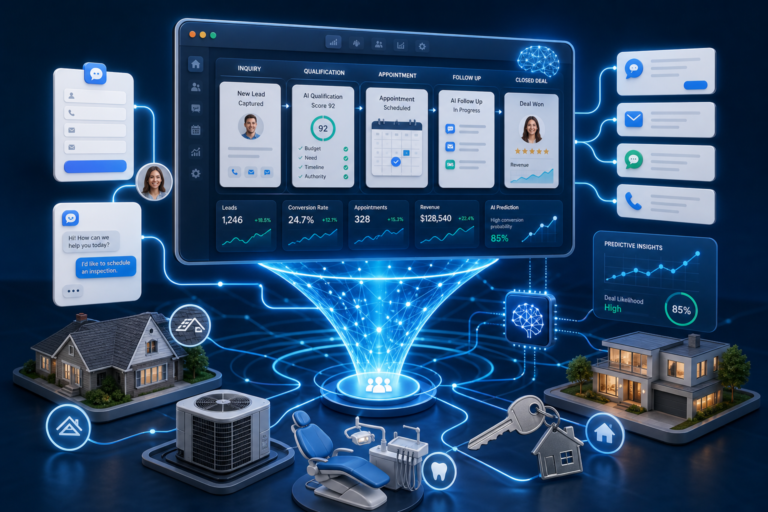

AI sales funnel automation transforms how businesses move prospects from initial contact to closed deals by using intelligent systems to manage every stage of the customer journey. Instead of relying on manual follow-ups, scattered spreadsheets, or delayed responses, modern sales teams use AI funnel automation to capture leads, qualify prospects, schedule appointments, and nurture relationships automatically. This shift from reactive selling to proactive automation helps service businesses reduce response times, increase conversion rates, and scale operations without adding headcount. GetDMFlow specializes in building these intelligent funnel systems for roofing companies, HVAC contractors, real estate professionals, dental practices, and other service providers who need reliable lead conversion infrastructure.
The core principle behind AI sales funnel automation is simple: automate repetitive tasks while maintaining personalized communication at scale. When a lead enters your system through a website form, phone call, or social media message, AI immediately responds, qualifies the prospect based on predefined criteria, and routes them through the appropriate workflow. This happens 24/7 without human intervention, ensuring no lead falls through the cracks during evenings, weekends, or busy periods when your team is occupied.
What Is AI Sales Funnel Automation
AI sales funnel automation uses artificial intelligence to manage the entire customer journey from lead capture to conversion without manual intervention at each step. The system identifies where prospects are in the buying process, delivers relevant information based on their behavior, and automatically moves them to the next stage when they meet specific criteria. Unlike traditional CRM systems that require sales reps to manually update records and send follow-up messages, automated funnel infrastructure handles these tasks based on triggers, conditions, and learning algorithms.
The technology combines natural language processing, behavioral tracking, predictive analytics, and workflow automation to create seamless customer experiences. When someone fills out a contact form at 11 PM, the system instantly sends a personalized response, asks qualifying questions, and schedules a consultation for the next available time slot. If the prospect doesn’t respond, the system automatically sends follow-up messages through their preferred channel at optimal times determined by engagement data.
For service businesses, this means converting more leads with fewer resources. A roofing company using AI lead nurturing systems can handle 200 monthly leads with the same team that previously struggled with 50. The system ensures consistent communication, immediate response times, and proper follow-up sequences that would be impossible to maintain manually.
Core Components of AI Funnel Workflows
AI funnel workflows consist of interconnected automation layers that work together to move prospects through your sales process. Each component handles a specific function while sharing data across the entire system to create cohesive customer experiences.
Lead Capture and Initial Response
The funnel begins when a prospect expresses interest through any channel: website forms, phone calls, SMS messages, social media, or live chat. AI lead response automation instantly acknowledges the inquiry within seconds, regardless of when it arrives. This immediate response dramatically increases engagement rates compared to businesses that take hours or days to reply.
The initial response includes personalized elements based on the lead source, service requested, and any information the prospect provided. For example, someone requesting a roof inspection receives different messaging than someone asking about emergency repairs. The system recognizes these distinctions and tailors communication accordingly.
Qualification and Segmentation
Once initial contact is established, the AI begins qualifying the lead through conversational questions that feel natural rather than robotic. The system asks about project timelines, budget ranges, specific needs, and decision-making authority while maintaining a helpful tone. Based on responses, prospects are automatically segmented into categories: hot leads ready to buy, warm leads needing nurturing, or cold leads requiring long-term follow-up.
This qualification process happens through multi-turn conversations where the AI adapts questions based on previous answers. If someone indicates urgency, the system prioritizes scheduling a same-day or next-day appointment. If they’re still researching options, the automation shifts to educational content delivery and periodic check-ins.
Appointment Scheduling and Confirmation
Qualified leads move into AI appointment booking automation where the system checks your team’s calendar availability, offers time slots that match the prospect’s stated preferences, and books confirmed appointments directly. The AI handles common scheduling complications like time zone differences, buffer times between meetings, and specific service requirements that affect appointment duration.
After booking, automated confirmation messages include calendar invites, preparation instructions, and pre-appointment information that reduces no-show rates. The system sends reminder messages at strategic intervals using the prospect’s preferred communication channel, whether that’s SMS, email, or messaging apps.
Nurturing and Follow-Up Sequences
Not every lead converts immediately, which is why AI follow-up automation plays a critical role in funnel performance. The system maintains contact with prospects through personalized follow-up sequences that adapt based on engagement signals. If someone opens every email but hasn’t responded, the automation tries a different approach like SMS or phone outreach. If they’ve gone silent, the system spaces out touches while continuing to provide value through educational content, case studies, or special offers.
These nurturing workflows can run for weeks or months, automatically adjusting message frequency and content based on how prospects interact with your communication. The AI identifies re-engagement opportunities when cold leads show renewed interest and immediately alerts your sales team or escalates the prospect to active status.
Conversion and Handoff
When prospects reach the decision stage, AI lead conversion automation ensures smooth transitions from marketing to sales. The system compiles all interaction history, qualification data, and behavioral insights into a comprehensive profile that your team reviews before meetings. This preparation time allows sales reps to focus on relationship building and closing rather than information gathering.
For service businesses using proposal-based selling, the automation can generate customized quotes or service packages based on the prospect’s stated needs and send them for review before scheduled consultations. This advance preparation shortens sales cycles and improves close rates by addressing common objections before they arise.
How AI Manages Multi-Stage Customer Journeys
Modern customer journeys rarely follow linear paths. Prospects enter at different stages, move backward when new questions arise, and take unpredictable actions based on changing circumstances. AI sales funnel automation handles this complexity by tracking individual journeys and adjusting workflows in real-time.
Dynamic Path Adjustment
When someone downloads a pricing guide, the system recognizes they’re in the consideration phase and delivers content appropriate for that stage. If the same person later visits emergency service pages, the AI detects the intent change and shifts them to a different workflow focused on immediate solutions. This dynamic adjustment happens automatically based on behavioral triggers without requiring manual segmentation updates.
The system maintains context across all interactions, so prospects never receive irrelevant messages or experience disjointed communication. If someone already scheduled an appointment, they stop receiving scheduling prompts and instead get preparation materials. This contextual awareness creates experiences that feel personalized rather than automated.
Cross-Channel Coordination
Prospects interact with businesses through multiple channels, often switching between email, SMS, phone calls, and website visits within the same buying journey. AI customer communication automation coordinates messages across all channels to prevent duplicate outreach or conflicting information. The system knows if someone received an email this morning and adjusts afternoon SMS timing accordingly.
This coordination extends to your team’s manual outreach as well. When a sales rep calls a prospect, the AI CRM automation pauses automated messages to prevent simultaneous contact from multiple sources. Once the call ends and notes are logged, the system resumes the appropriate workflow based on the conversation outcome.
Behavioral Trigger Response
The AI constantly monitors prospect behavior for signals that indicate changing intent or readiness to move forward. When someone visits your pricing page three times in two days, the system recognizes this as a buying signal and adjusts the workflow to include direct sales outreach or special offer messaging. If a prospect who went cold suddenly opens multiple emails and clicks through to service pages, the automation re-engages them with timely follow-up.
These behavioral triggers work alongside time-based sequences to create responsive rather than rigid automation. The system balances scheduled touches with reactive outreach based on what prospects are actually doing, not just what the calendar says they should receive.
Technical Infrastructure Behind Automated Funnels
Building effective AI funnel workflows requires robust technical infrastructure that connects data sources, executes automation rules, and scales with business growth. Service businesses don’t need to understand every technical detail, but knowing how these systems work helps you evaluate platforms and make informed implementation decisions.
Integration Architecture
AI sales funnel automation platforms integrate with existing business tools to create unified customer data systems. Connections to your website forms, phone system, email platform, calendar software, and payment processors ensure information flows seamlessly between systems without manual data entry. When a lead fills out a contact form, their information automatically appears in your CRM, triggers the appropriate workflow, and updates across all connected platforms.
GetDMFlow’s features include native integrations with popular business tools plus API connections for custom requirements. This flexibility means you don’t have to replace working systems to gain automation benefits. The platform layers intelligent automation on top of your current infrastructure.
Natural Language Processing
The conversational capabilities that make AI automation feel human come from natural language processing technology. The system understands prospect questions, interprets intent behind messages, and generates contextually appropriate responses. This goes beyond simple keyword matching to actual comprehension of what prospects are asking and what information they need.
For service businesses, this means the AI can handle complex questions about services, pricing, availability, and processes without scripted responses that feel robotic. When someone asks about payment plans, the system understands they’re expressing budget concerns and responds with relevant financing information rather than generic service descriptions.
Machine Learning and Optimization
AI funnel automation improves over time through machine learning algorithms that identify patterns in successful conversions. The system analyzes which message sequences generate the highest response rates, which qualification questions best predict conversion likelihood, and which follow-up timing produces optimal engagement. These insights automatically refine workflows without requiring constant manual adjustments.
For example, if data shows prospects who receive follow-up messages on Tuesday mornings respond 40% more than those contacted on Friday afternoons, the system adjusts send times across all workflows. This continuous optimization happens in the background while maintaining your core automation strategy.
Security and Compliance Infrastructure
Automated systems handling customer data require strong security measures and compliance frameworks. Enterprise-grade platforms include encryption for data in transit and at rest, role-based access controls, audit logging, and compliance certifications for relevant regulations. For Canadian businesses like GetDMFlow, this includes PIPEDA compliance alongside international standards.
Service businesses in regulated industries like healthcare, legal services, or financial services need automation platforms that support industry-specific compliance requirements. The infrastructure should include consent management, data retention policies, and secure communication channels that meet professional standards.
Implementation Process for Service Businesses
Moving from manual sales processes to AI funnel automation requires strategic planning and phased implementation. Service businesses that rush deployment often struggle with adoption, while those that take systematic approaches see faster ROI and smoother team transitions.
Funnel Mapping and Strategy
Successful implementation starts with mapping your current customer journey from initial contact to closed sale. Document every touchpoint, identify where leads currently drop off, and pinpoint manual tasks that slow conversion. This mapping reveals which funnel stages need automation most urgently and where AI can deliver the biggest impact.
For a roofing company, the map might show strong lead generation but poor follow-up after initial estimates. The automation strategy would focus on post-estimate nurturing sequences that keep prospects engaged during the decision period. An HVAC contractor might discover most leads arrive outside business hours, making immediate response automation the top priority.
Workflow Configuration
Once strategy is clear, you configure specific workflows that automate identified processes. This includes setting up trigger conditions, designing message sequences, creating qualification criteria, and establishing handoff rules between automation and human team members. The goal is replicating your best sales processes in automated form while improving consistency and speed.
Platforms like GetDMFlow provide pre-built workflow templates for common service business scenarios, which you customize based on your specific needs. These templates accelerate implementation by providing proven structures you adapt rather than building from scratch. You can explore implementation options by booking a demo to see workflows relevant to your industry.
Team Training and Adoption
Automation works best when your team understands how to work alongside AI systems rather than viewing them as replacements. Training should cover how to interpret automation alerts, when to take over conversations from AI, and how to use the data and insights the system generates. Sales reps need to see automation as a tool that gives them more time for high-value activities rather than technology that threatens their roles.
Change management matters as much as technical configuration. Involve your team in workflow design, address concerns about automation impact, and create clear guidelines for human-AI collaboration. Teams that embrace automation early become advocates who help refine processes and identify new automation opportunities.
Testing and Optimization
Before fully launching automated funnels, test workflows with small lead volumes to identify issues and refine messaging. Monitor how prospects respond to AI conversations, track where people exit workflows, and gather feedback from team members handling automated handoffs. This testing phase reveals gaps between intended automation behavior and actual performance.
Once live, continuous optimization ensures your funnels stay effective as markets change and your business evolves. Regular reviews of conversion data, message performance, and funnel velocity help you identify optimization opportunities. The AI handles automatic improvements, but strategic decisions about workflow structure and messaging approach still benefit from human oversight.
Measuring AI Funnel Performance
AI sales funnel automation generates detailed performance data that helps you understand what’s working and where to focus improvement efforts. Unlike manual processes where tracking is inconsistent, automated systems capture every interaction and outcome for comprehensive analysis.
Key Performance Indicators
The most important metrics for automated funnel performance include response time to new leads, qualification rate, appointment booking rate, show rate for scheduled appointments, and overall lead-to-customer conversion rate. These KPIs reveal how effectively your automation moves prospects through each funnel stage.
Compare these metrics to your pre-automation baseline to quantify ROI. A roofing company that previously converted 8% of leads might see that number rise to 15% with automated follow-up and nurturing. An HVAC contractor who averaged four-hour response times might reduce that to under one minute with AI lead response automation.
Funnel Velocity and Stage Duration
Beyond conversion rates, measure how long prospects spend in each funnel stage. Faster movement through qualification and scheduling stages means you’re closing deals more quickly and reducing the window where competitors can intervene. Longer nurturing periods might indicate messaging issues or qualification criteria that need adjustment.
AI systems track stage duration automatically and alert you when prospects stall at specific points. If leads consistently pause after receiving pricing information, that signals a need for better value communication or pricing presentation. If appointment no-shows spike on certain days, the system identifies patterns you can address through scheduling changes or improved reminder messaging.
Channel Performance Analysis
Automated funnels operate across multiple communication channels, and performance varies by channel type. Some prospects prefer email communication while others respond better to SMS. The AI tracks engagement by channel and automatically adjusts outreach methods based on individual preferences, but aggregate data helps you understand overall channel effectiveness.
This analysis reveals which channels drive the best quality conversations and highest conversion rates. You might discover that SMS generates faster responses but email produces more qualified leads, leading to strategic decisions about which channels to emphasize at different funnel stages.
ROI and Business Impact
The ultimate measure of AI funnel automation success is business impact. Calculate ROI by comparing automation costs against increased revenue from higher conversion rates and larger deal volumes. Factor in time savings for your team, reduced missed opportunities, and capacity to handle more leads without adding staff.
For most service businesses, automated funnel ROI becomes positive within the first few months as conversion improvements and efficiency gains outpace platform costs. The ROI grows over time as the system learns from more interactions and you refine workflows based on performance data. You can explore pricing options that align with your business size and expected lead volume.
Industry-Specific Funnel Applications
AI sales funnel automation adapts to the unique requirements of different service industries. While core principles remain consistent, successful implementations customize workflows for industry-specific buying cycles, customer expectations, and operational constraints.
Home Services and Contractors
Roofing companies, HVAC contractors, plumbing businesses, and other home service providers benefit from automation that handles emergency requests differently than planned projects. The AI recognizes urgency signals in customer messages and routes emergency leads to immediate response workflows while sending project inquiries through qualification and estimation processes.
These businesses typically see the strongest ROI from automated follow-up after estimates, where many leads go cold. The system maintains contact during decision periods, addresses common objections, and re-engages prospects who went silent. Seasonal businesses use automation to nurture off-season leads until buying conditions improve.
Real Estate Professionals
Real estate agents and brokerages use AI funnel automation to manage buyer and seller leads through long consideration periods. The system qualifies prospects based on timeline, budget, location preferences, and property requirements, then delivers relevant listings and market information automatically. For sellers, automation provides property valuation information, market analysis, and preparation guides while nurturing toward listing appointments.
The extended sales cycles common in real estate make automation particularly valuable. Manual follow-up over 6-12 month periods is inconsistent, but automated systems maintain contact through market updates, new listing alerts, and periodic check-ins that keep agents top-of-mind when prospects are ready to move.
Healthcare and Wellness Practices
Dental practices, med spas, chiropractic offices, and other healthcare providers use automation for appointment booking, patient intake, and service education. The AI handles initial appointment requests, collects necessary patient information, and sends preparation instructions while maintaining HIPAA compliance through secure communication channels.
These practices often struggle with no-shows that waste valuable appointment slots. Automated reminder sequences with confirmation requests significantly reduce no-show rates while freeing front desk staff from manual reminder calls. The system can also identify patients overdue for regular appointments and send re-engagement messages that bring them back to the practice.
Professional Services
Law firms, accounting practices, consulting businesses, and agencies use AI funnel automation to qualify leads based on practice area fit, project scope, and budget alignment before scheduling consultations. The system collects case details or project requirements in advance, allowing professionals to review situations before meetings and provide more valuable initial consultations.
For professional services where expertise and trust drive buying decisions, automation focuses on educational content delivery and credibility building. The AI shares relevant case studies, explains service processes, and addresses common concerns while positioning the firm as the expert solution.
Explore how industries use AI sales funnel automation for their specific operational needs and customer journey requirements.
Common Implementation Challenges
While AI funnel automation delivers significant benefits, businesses face predictable challenges during implementation. Understanding these obstacles helps you plan mitigation strategies and set realistic expectations.
Data Quality and Integration Issues
Automation effectiveness depends on clean, organized customer data. Businesses with scattered information across multiple systems, duplicate records, or incomplete contact details struggle to implement smooth workflows. The AI needs accurate data to trigger appropriate actions and personalize communication.
Address data quality before launching automation by cleaning your CRM, standardizing data entry practices, and establishing integration between systems. This upfront work prevents automation failures caused by missing information or incorrect contact details. Ongoing data hygiene practices keep the system running smoothly as lead volume grows.
Balancing Automation and Human Touch
Finding the right balance between automated efficiency and personal connection challenges many service businesses. Over-automation makes interactions feel robotic and impersonal, while too much manual involvement defeats the purpose of automation. The goal is using AI for routine tasks while reserving human attention for high-value conversations.
Start with conservative automation of clear-cut repetitive tasks like initial response, appointment confirmation, and basic qualification. Keep humans involved in complex discussions, objection handling, and relationship building. Over time, as you see what the AI handles well, you can expand automated responsibilities while maintaining quality standards.
Team Resistance and Adoption Friction
Sales teams sometimes resist automation, fearing technology will replace them or that automated communication will damage customer relationships. This resistance slows implementation and prevents businesses from realizing full automation benefits. Address these concerns through transparent communication about automation goals and active involvement in workflow design.
Frame automation as a tool that eliminates tedious tasks so team members can focus on activities they find more rewarding and that generate higher value. Show how automation increases lead volume and quality, creating more opportunities rather than reducing the need for skilled sales professionals.
Message Quality and Brand Voice
Automated messages must sound natural and align with your brand voice, which requires careful writing and testing. Generic template messages feel robotic and damage trust, while overly casual communication might not match professional service expectations. The AI needs well-crafted message libraries that maintain consistent quality across all automated touchpoints.
Invest time in writing strong initial messages that sound like your best team members wrote them. Test different approaches with small lead groups and refine based on response rates and feedback. The natural language capabilities in platforms like GetDMFlow help, but thoughtful message design remains important for optimal results.
Future Developments in AI Funnel Automation
AI sales funnel automation continues advancing rapidly, with emerging capabilities that will further transform how service businesses convert leads. Understanding these trends helps you prepare for coming changes and evaluate platform innovation.
Predictive Lead Scoring
Next-generation AI funnel systems will predict which leads are most likely to convert before they complete the journey. By analyzing behavioral patterns, engagement signals, and historical data from similar prospects, the AI assigns probability scores that help prioritize team attention. High-probability leads receive immediate human outreach while lower-scoring prospects continue through automated nurturing.
This predictive capability reduces wasted effort on leads unlikely to convert while ensuring hot prospects get maximum attention. The scoring models improve continuously as the system learns from more conversion outcomes and refines its understanding of what signals indicate buying readiness.
Voice and Conversational AI
Voice-based AI automation will handle phone conversations with the same sophistication current systems apply to text-based communication. Prospects can call your business, interact with AI that understands natural speech, answer qualification questions verbally, and schedule appointments through voice commands. The system transcribes conversations for CRM records and triggers appropriate follow-up workflows.
This capability removes communication channel limitations, allowing full automation regardless of how prospects prefer to interact. Businesses can offer 24/7 phone availability without after-hours staffing costs while maintaining consistent qualification and scheduling processes.
Hyper-Personalization
Future AI systems will generate unique messages for each prospect based on their specific situation rather than selecting from pre-written templates. The AI will analyze available data about the prospect’s business, industry, location, and stated needs to craft truly personalized communication that addresses their exact circumstances.
This hyper-personalization creates experiences indistinguishable from human-written messages while maintaining automation scalability. Prospects receive communication that feels crafted specifically for them because it actually is, just generated by AI rather than typed by a sales rep.
Cross-Platform Ecosystem Integration
AI funnel automation will integrate more deeply with broader business operations beyond sales and marketing. Connections to project management systems, service delivery platforms, and customer success tools will create end-to-end automated customer experiences from first contact through service completion and retention.
For service businesses, this means automation that doesn’t stop at conversion but continues optimizing the entire customer relationship. The same AI that booked the initial appointment can schedule follow-up services, request reviews, and identify upsell opportunities throughout the customer lifecycle.
Frequently Asked Questions
What is AI sales funnel automation?
AI sales funnel automation uses artificial intelligence to manage the entire customer journey from lead capture to conversion without manual intervention at each step. The system automatically responds to inquiries, qualifies prospects, schedules appointments, sends follow-up messages, and moves leads through your sales process based on behavioral triggers and predefined workflows.
How does AI funnel automation differ from traditional CRM?
Traditional CRM systems store customer data and track interactions but require sales reps to manually update records and execute follow-up tasks. AI funnel automation actively manages customer journeys by automatically responding to leads, qualifying prospects, and executing multi-step workflows based on customer behavior and engagement signals without requiring manual action at each stage.
What types of businesses benefit most from automated funnels?
Service-based businesses with high lead volumes and repeatable sales processes gain the most value from AI sales funnel automation. This includes home service contractors, real estate professionals, healthcare practices, professional services firms, and local businesses that need to respond quickly to inquiries, qualify prospects efficiently, and maintain consistent follow-up over extended sales cycles.
How long does it take to implement AI funnel automation?
Basic AI funnel automation can launch within 2-4 weeks, including strategy development, workflow configuration, integration setup, and team training. More complex implementations with extensive customization and multiple workflow paths may take 6-8 weeks. The timeline depends on data quality, integration requirements, and workflow complexity for your specific business.
Does automation replace human sales teams?
No, AI funnel automation handles repetitive tasks and routine communication so human sales teams can focus on relationship building, complex problem-solving, and closing deals. The technology works alongside your team by qualifying leads, scheduling appointments, and maintaining follow-up, then handing off to humans for high-value conversations. This increases team productivity rather than replacing people.
How much does AI sales funnel automation cost?
AI sales funnel automation platforms typically charge monthly subscription fees based on lead volume, number of users, and feature requirements. Pricing ranges from a few hundred dollars monthly for small businesses to several thousand for enterprises with high lead volumes. Calculate ROI by comparing subscription costs against increased revenue from improved conversion rates and operational efficiency gains.
Can AI automation handle complex customer questions?
Modern AI systems using natural language processing can understand and respond to many complex questions about services, pricing, availability, and processes. The AI recognizes when questions exceed its capabilities and smoothly hands off to human team members for specialized support. This balance ensures customers get accurate information while maintaining automation efficiency for routine inquiries.
What happens if the AI makes a mistake?
AI funnel automation includes safeguards like human review triggers for important decisions, confidence scoring that flags uncertain responses, and escalation protocols that involve team members when situations require human judgment. The system logs all interactions for quality review, and businesses can adjust workflows based on identified issues to prevent repeated mistakes.
How does AI automation handle multiple communication channels?
AI sales funnel automation coordinates communication across email, SMS, phone, website chat, and social media messaging from a unified platform. The system tracks all interactions regardless of channel, maintains context across touchpoints, and prevents duplicate outreach by coordinating automated and manual messages. Prospects can switch between channels while the AI maintains conversation continuity.
What integration capabilities do AI funnel platforms need?
Effective AI funnel automation requires integration with your website forms, phone system, email platform, calendar software, CRM, and payment processing. Native integrations with popular business tools simplify setup, while API connections enable custom requirements. The platform should sync data bidirectionally so information flows seamlessly between systems without manual entry.
How do I measure ROI from funnel automation?
Measure AI funnel automation ROI by tracking lead response time, qualification rate, appointment booking rate, conversion rate, and average deal size before and after implementation. Calculate increased revenue from improved conversion rates and higher lead volumes, then subtract platform costs and implementation expenses. Most service businesses see positive ROI within 3-6 months as conversion improvements compound.
Is my customer data secure with AI automation?
Enterprise-grade AI funnel automation platforms include encryption for data in transit and at rest, role-based access controls, audit logging, and compliance certifications for relevant regulations. Verify that platforms meet security standards for your industry and location, including GDPR, PIPEDA, HIPAA, or other applicable requirements. GetDMFlow maintains Canadian data security standards and international compliance frameworks.
Transform Your Sales Process with Intelligent Automation
AI sales funnel automation represents a fundamental shift from reactive selling to proactive conversion systems. Service businesses that implement intelligent funnel workflows respond faster to leads, maintain consistent follow-up, and convert more prospects without expanding sales teams. The technology handles routine tasks automatically while giving your team more time for relationship building and complex problem-solving that drives revenue growth.
The implementation process requires strategic planning, workflow customization, and team adoption, but businesses that commit to proper deployment see measurable improvements in response times, conversion rates, and operational efficiency. As AI capabilities continue advancing, early adopters gain competitive advantages through refined workflows, accumulated performance data, and organizational experience with automation-enhanced selling.
GetDMFlow provides the AI sales funnel automation infrastructure service businesses need to capture, qualify, and convert more leads through intelligent automated workflows. The platform combines immediate lead response, conversational qualification, appointment scheduling, and multi-channel follow-up in a unified system designed specifically for service business requirements. Book a demo to see how AI funnel automation can transform your lead conversion process and accelerate business growth.
