
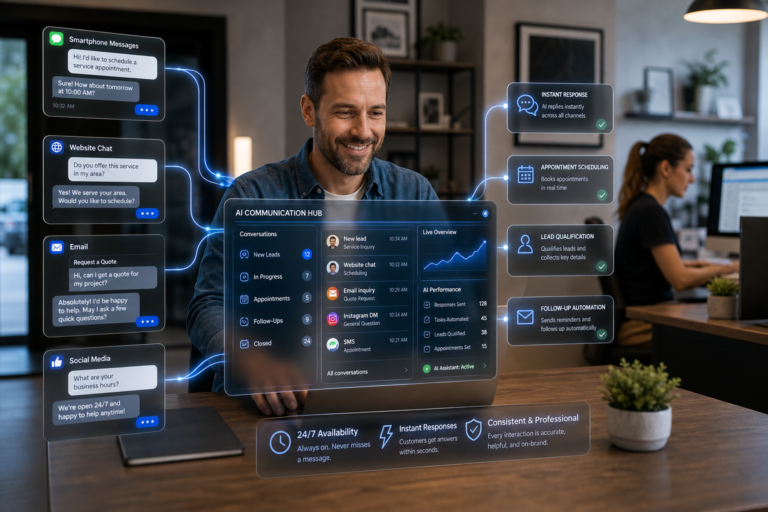

AI communication systems help service businesses respond instantly across channels, automate routine customer interactions, and maintain conversation context without sacrificing personalization. The content explains how faster replies, lead qualification, appointment booking, and follow-up automation can improve conversion rates and reduce manual workload.
It also covers integration with CRM and scheduling tools, performance analytics, and the balance between automation and human support. The post argues that businesses using these systems can improve customer experience, operate more efficiently, and stay competitive as expectations for speed and consistency rise.
Customer expectations have changed. People expect instant responses, consistent engagement, and seamless conversations across every channel. Missing a single inquiry can mean losing a customer to a competitor who responded faster. Traditional communication methods struggle to keep up with modern demand, creating gaps that cost businesses revenue and credibility.
AI communication systems solve this problem by automating customer interactions without sacrificing quality or personalization. These systems handle inquiries 24/7, maintain conversation context across channels, and ensure every lead receives immediate attention. For service businesses competing in crowded markets, implementing intelligent messaging automation is no longer optional. It’s the foundation of competitive customer engagement.
The Communication Gap in Modern Business
Most businesses lose opportunities during communication delays. A customer sends an inquiry through Instagram, follows up via text, then calls when they don’t get a response. By the time someone manually checks all channels, that customer has already chosen a competitor. This fragmented approach creates frustration on both sides.
Manual communication management also limits scalability. A team of three can only handle so many conversations simultaneously. During peak hours or seasonal rushes, response times slow down dramatically. Customers notice these delays and interpret them as lack of professionalism or interest in their business.
The financial impact is significant. Research shows that businesses responding within five minutes are 100 times more likely to convert leads than those responding after 30 minutes. Every delayed response represents potential revenue walking out the door. Service businesses especially feel this pressure, where timing often determines who wins the job.
What AI Communication Systems Actually Do
AI communication systems automate the entire customer conversation lifecycle. They capture inquiries from websites, social media, SMS, and other channels, then engage each lead with contextually relevant responses. The system asks qualifying questions, answers common concerns, and routes complex issues to human team members when needed.
These platforms maintain conversation history across all touchpoints. If a customer starts a conversation on Facebook and continues via SMS, the system remembers the context. This continuity creates smoother experiences and prevents customers from repeating themselves.
AI customer communication automation handles routine tasks that consume staff time. Appointment scheduling, service explanations, pricing questions, and availability checks happen automatically. Staff members focus on high-value activities like closing deals and handling complex customer needs.
Real-Time Response Capabilities
Speed matters in customer communication. AI systems respond within seconds, regardless of when inquiries arrive. A lead submitting a contact form at 2 AM receives immediate engagement instead of waiting until business hours. This instant response dramatically increases conversion probability.
The system handles multiple conversations simultaneously without quality degradation. Whether processing five inquiries or fifty, response time remains consistent. During high-volume periods, this capability prevents the bottlenecks that plague manual systems.
Automatic follow-up sequences ensure no lead falls through cracks. If a potential customer doesn’t respond to the initial message, the system sends strategically timed follow-ups. These touchpoints keep your business top-of-mind without requiring manual tracking.
Key Benefits for Service Businesses
Service businesses face unique communication challenges. Customers need detailed information about services, pricing structures, availability, and qualifications before making decisions. Providing this information manually for every inquiry consumes enormous time and resources.
Automated customer communication delivers consistent information regardless of who asks or when. A roofing company can automatically explain different material options, warranty details, and typical project timelines. This consistency prevents miscommunication and sets accurate expectations.
The system qualifies leads before they reach your sales team. By asking targeted questions about project scope, timeline, and budget, the AI identifies which leads are ready to convert. Your team spends time on qualified opportunities instead of sorting through unqualified inquiries.
Operational Efficiency Improvements
Staff productivity increases when routine communication is automated. Team members who previously spent hours answering basic questions can focus on complex problem-solving and relationship building. This shift improves job satisfaction and allows businesses to handle more customers without proportionally increasing headcount.
Communication consistency strengthens brand perception. Every customer receives the same level of attention and professionalism, whether they’re the first inquiry of the day or the fiftieth. This consistency builds trust and reinforces your reputation for reliability.
Data collection happens automatically during conversations. The system captures customer preferences, pain points, common objections, and decision factors. This information helps businesses refine offerings and improve marketing messages based on actual customer input.
How AI Communication Systems Improve Customer Experience
Customers value convenience above almost everything else. AI communication systems let them engage on their preferred channels at their preferred times. Someone comfortable with text messaging can handle everything via SMS. Another customer who prefers web chat gets the same quality experience through that channel.
Wait times disappear. Customers accustomed to leaving voicemails or waiting for email responses receive immediate engagement instead. This responsiveness creates positive first impressions that influence purchasing decisions.
Conversation quality remains high because the system draws from comprehensive knowledge bases. Answers are accurate, relevant, and helpful. Customers get the information they need without frustration or confusion.
Personalization at Scale
AI systems personalize interactions based on customer data and behavior. A returning customer receives different messaging than a first-time visitor. Someone who previously inquired about premium services sees relevant upsell opportunities. This personalization makes customers feel recognized and valued.
The technology adapts tone and complexity to match customer communication styles. Someone asking technical questions receives detailed explanations. A customer using casual language gets friendly, accessible responses. This adaptability improves comprehension and comfort.
Appointment booking becomes frictionless. Customers see available time slots, select their preference, and receive confirmation without human intervention. They can reschedule or cancel through the same automated interface, reducing administrative burden on both sides.
Integration with Existing Business Systems
Modern AI communication platforms connect with CRM systems, scheduling tools, payment processors, and other business software. This integration ensures information flows seamlessly between systems without manual data entry.
When a customer books an appointment through the AI system, that appointment automatically appears in your calendar. Customer information populates your CRM. Follow-up sequences trigger based on appointment status. This automation eliminates the disconnected processes that create errors and inefficiencies.
AI CRM automation maintains accurate customer records without staff involvement. Every interaction, preference, and piece of information gets logged automatically. Sales teams access complete customer histories before conversations, enabling more informed and productive discussions.
Multi-Channel Synchronization
Customers switch between channels frequently. They might start on your website, continue via text, and finish with a phone call. AI systems synchronize these conversations so context is never lost. Your team sees the complete interaction history regardless of which channel the customer used.
This synchronization prevents redundant questions and miscommunication. Customers don’t need to repeat information they’ve already provided. Staff members pick up conversations exactly where they left off, creating seamless experiences.
The system routes conversations to appropriate team members based on content and urgency. Technical questions go to technical staff. Pricing discussions route to sales. Urgent issues escalate immediately. This intelligent routing ensures customers reach the right person quickly.
Measuring Communication System Performance
AI communication platforms provide detailed analytics about customer interactions. Businesses see response times, conversation volumes, common questions, conversion rates, and engagement patterns. This data reveals what’s working and where improvements are needed.
Response time metrics show how quickly customers receive initial engagement and follow-up messages. Businesses can set benchmarks and monitor performance against those standards. Consistent measurement drives continuous improvement.
Conversion tracking connects communication activities to business results. You see which message sequences generate appointments, which channels produce qualified leads, and which automation workflows drive revenue. This visibility enables data-driven optimization.
Continuous Improvement Through Data
Conversation logs reveal customer pain points and objections. Analyzing these patterns helps businesses address concerns proactively. If customers frequently ask about warranties, that information should be more prominent in marketing materials and initial conversations.
The system identifies bottlenecks in customer journeys. Maybe customers drop off at a specific question or hesitate at a particular step. Recognizing these friction points allows businesses to smooth the path to conversion.
A/B testing capabilities let businesses experiment with different messages, sequences, and approaches. You can test various appointment confirmation formats, follow-up timing, or qualification questions. The system measures which variations perform better, enabling evidence-based decisions.
Common Concerns About AI Communication
Many businesses worry that AI communication feels impersonal or robotic. Modern systems avoid this problem by using natural language and contextual awareness. Conversations feel genuine because the technology understands intent and responds appropriately.
The fear of losing human connection is understandable but misplaced. AI systems handle routine tasks so humans can focus on relationship-building activities. Customers get faster, more consistent service for basic needs, while complex situations receive appropriate human attention.
Some worry about implementation complexity. Quality platforms are designed for ease of use, with intuitive interfaces and comprehensive support. Most businesses complete setup within days and see immediate results.
Balancing Automation and Human Touch
The goal isn’t replacing humans but enhancing their capabilities. AI business messaging systems handle volume and repetition while humans provide expertise and empathy. This combination delivers better outcomes than either approach alone.
Businesses maintain control over when conversations transfer to human team members. You set rules based on complexity, customer value, or specific triggers. High-value leads or sensitive situations receive immediate human attention.
Customers appreciate efficiency more than they resist automation. When AI systems provide accurate information quickly, satisfaction increases. Problems only arise when automation is poorly implemented or customers can’t reach humans when needed.
Choosing the Right AI Communication Platform
Not all AI communication systems deliver equal value. Service businesses need platforms designed for their specific workflows and challenges. Generic chatbot tools lack the depth and customization required for complex service sales.
Look for platforms with robust multi-channel capabilities. Your system should handle website chat, SMS, social media messages, and email through a single interface. Fragmented systems create the same problems they’re meant to solve.
Integration capabilities matter significantly. The platform should connect with your existing CRM, scheduling system, and other tools. Standalone systems that don’t integrate create data silos and manual work.
Platform Features That Matter
Appointment booking automation is critical for service businesses. The system should handle scheduling, reminders, confirmations, and rescheduling without human intervention. This capability directly impacts conversion rates and no-show reduction.
Lead qualification functionality separates serious prospects from casual browsers. The platform should ask strategic questions that reveal purchase intent, timeline, and budget. This information helps sales teams prioritize efforts effectively.
Customization options allow businesses to align automation with brand voice and specific processes. You should be able to modify conversation flows, adjust qualification criteria, and personalize messaging. Rigid systems that can’t adapt to your business create frustration.
Implementation Strategy for AI Communication
Successful implementation starts with clear goals. What specific communication problems are you solving? Are you focused on response speed, lead qualification, appointment booking, or operational efficiency? Clear objectives guide platform selection and configuration.
Map your current customer journey before implementing automation. Identify touchpoints where communication happens, pain points where delays occur, and opportunities where automation would add value. This mapping ensures your AI system addresses actual needs.
Start with high-impact, low-complexity use cases. Automating appointment confirmations or answering FAQ questions provides quick wins that build confidence. Expand to more complex workflows after establishing baseline success.
Training and Optimization
AI systems improve with training and feedback. Initially, review conversations to ensure accuracy and appropriateness. Make adjustments to improve responses based on actual customer interactions. This refinement process enhances performance over time.
Train your team on working alongside AI systems. They need to understand when to intervene, how to access conversation histories, and how to use data provided by the platform. Proper training ensures smooth human-AI collaboration.
Set review cycles for ongoing optimization. Monthly or quarterly reviews of analytics, conversation quality, and conversion rates reveal improvement opportunities. Continuous optimization maximizes return on investment.
Industry-Specific Applications
Different industries benefit from AI communication in unique ways. Roofing companies use it to explain material options and schedule inspections. HVAC contractors automate seasonal maintenance reminders and emergency service requests. Real estate professionals manage showing schedules and property inquiries.
Med spas handle appointment bookings, service explanations, and consultation scheduling automatically. Law firms qualify potential clients and gather case information before initial consultations. Solar companies manage complex multi-step sales processes with automated follow-up sequences.
The common thread across industries is improved speed and consistency in customer communication. Every service business faces similar challenges around lead response, appointment management, and customer engagement. AI communication systems address these universal needs while adapting to industry-specific requirements.
The Competitive Advantage of AI Communication
Businesses that implement AI communication systems gain significant competitive advantages. They respond faster than competitors still using manual methods. They engage more leads with the same team size. They convert higher percentages of inquiries into appointments and sales.
This advantage compounds over time. As competitors struggle with manual processes, your business scales effortlessly. You capture market share by providing superior customer experiences and operational efficiency.
The technology barrier to entry is low enough that any business can implement these systems, but high enough that many haven’t yet. Early adopters gain momentum that becomes increasingly difficult for late adopters to overcome.
Future-Proofing Your Business
Customer expectations will continue rising. The speed and quality of communication that impresses customers today will be baseline expectations tomorrow. Businesses that establish strong communication infrastructure now will adapt more easily to future demands.
AI communication technology improves rapidly. Platforms that seem advanced today will be standard tomorrow. Building organizational capability with these systems positions businesses to leverage future innovations.
The data collected through AI communication systems becomes increasingly valuable. Customer insights, behavior patterns, and engagement trends inform strategic decisions beyond just communication. This data asset grows with every interaction.
Frequently Asked Questions
What is an AI communication system?
An AI communication system automates customer conversations across multiple channels using intelligent technology. It captures inquiries, engages leads, answers questions, schedules appointments, and manages follow-up workflows without human intervention. These systems maintain conversation context, integrate with business tools, and provide analytics about customer interactions.
How is AI communication different from chatbots?
Traditional chatbots provide scripted responses to specific keywords. AI communication systems understand context, intent, and conversation flow. They handle complex multi-turn conversations, maintain context across channels, and integrate deeply with business processes. The technology focuses on complete communication automation rather than just answering basic questions.
Will AI communication replace my customer service team?
No. AI communication systems handle routine, repetitive tasks so your team can focus on complex situations requiring human judgment and empathy. The technology increases team productivity and allows them to serve more customers effectively. Most businesses find they need the same team size but achieve much better results.
How long does it take to implement AI communication?
Most businesses complete initial implementation within one to two weeks. Basic functionality like lead capture and appointment booking works immediately. More complex workflows involving integrations and custom qualification processes may take additional time. The platform begins providing value from day one while you optimize over time.
What ROI can businesses expect from AI communication systems?
Businesses typically see 30-50% increases in lead conversion rates due to faster response times and consistent engagement. Operational costs decrease as automation handles tasks previously requiring staff time. Specific ROI varies based on business size, implementation quality, and industry, but most businesses achieve positive ROI within three to six months.
How do customers react to AI communication?
Customers respond positively when AI systems provide accurate, helpful information quickly. They appreciate instant responses and 24/7 availability. Satisfaction issues only arise when systems provide poor answers or make reaching humans difficult. Well-implemented AI communication improves customer satisfaction scores and reduces frustration.
Can AI communication systems handle complex inquiries?
AI systems handle structured complexity well, such as multi-step qualification or detailed service explanations. They struggle with highly nuanced situations requiring deep expertise or emotional intelligence. Quality platforms recognize when conversations exceed their capabilities and smoothly transfer to human team members. This balance ensures customers always get appropriate support.
What channels do AI communication systems support?
Modern platforms support website chat, SMS, Facebook Messenger, Instagram DMs, WhatsApp, email, and other common channels. The system synchronizes conversations across all channels so customers can switch freely without losing context. Multi-channel support ensures you meet customers wherever they prefer to communicate.
Transform Your Customer Communication Today
Every delayed response costs your business opportunities. Every manual process limits your growth potential. Every inconsistent interaction weakens your brand. AI communication systems solve these problems by automating customer engagement while maintaining quality and personalization.
Service businesses implementing these systems respond instantly to every inquiry, qualify leads automatically, book appointments without staff involvement, and maintain consistent communication across all channels. The result is higher conversion rates, better customer experiences, and more efficient operations.
GetDMFlow provides comprehensive AI sales automation designed specifically for service businesses. Our platform automates lead response, customer communication, appointment booking, and follow-up workflows across multiple channels. We help businesses capture more opportunities, engage customers effectively, and convert leads into revenue.
The competitive landscape rewards businesses that respond faster and communicate better. AI communication systems provide that advantage. The question isn’t whether to implement this technology, but how quickly you can gain its benefits before competitors do. Your customers expect instant, personalized engagement. AI communication systems deliver that experience at scale, turning your customer communication into a growth engine rather than an operational burden.
