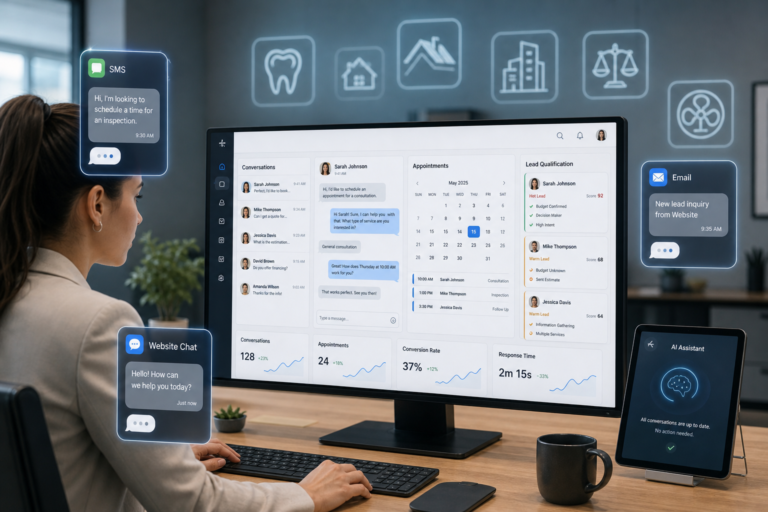

Yes, AI can fully automate customer conversations and appointment booking by using intelligent automation systems that understand customer intent, provide relevant responses, and schedule appointments without human intervention. Modern AI sales automation platforms handle initial contact, answer questions, qualify leads, and complete the booking process in real time.
What Does AI Automation of Customer Conversations Mean?
AI automation of customer conversations refers to using artificial intelligence to handle communication with prospects and customers automatically. This includes responding to inquiries, answering questions, providing information, qualifying interest levels, and guiding people toward specific actions like booking appointments.
Unlike traditional automated responses that follow rigid scripts, modern AI systems understand context and intent. They recognize what customers are asking, even when questions are phrased differently. The system adapts its responses based on the conversation flow and customer needs. This creates a natural experience that feels personalized rather than robotic.
AI handles conversations across multiple channels. Whether someone reaches out through website chat, text message, social media, or email, the system responds consistently. This creates a seamless experience regardless of how customers choose to communicate. For service-based businesses like roofing companies or dental practices, this means never missing a potential customer because someone was unavailable to respond.
How AI Handles Customer Conversations
AI systems process customer conversations through several key capabilities. Natural language processing allows the system to understand what customers mean, not just what they say. When someone asks about availability next week, the AI recognizes this as a scheduling request. When they inquire about pricing, the system understands they need cost information.
The automation works through decision trees and conversation flows. Based on customer responses, the AI determines the next appropriate step. If someone expresses interest in a service, the system moves toward qualification and booking. If they need more information first, it provides relevant details before advancing the conversation.
AI lead response automation ensures immediate engagement. When a new inquiry comes in, the system responds within seconds. This speed is critical for conversion because leads expect fast responses. Studies show that responding within five minutes increases conversion rates by up to 400% compared to waiting 30 minutes. AI makes this instant response possible 24 hours a day.
The system maintains conversation context throughout the interaction. If a customer mentions they need emergency service, the AI remembers this detail and prioritizes scheduling accordingly. This contextual awareness creates natural conversations that don’t feel repetitive or disconnected.
AI Appointment Booking Automation
AI appointment booking automation eliminates the back-and-forth typically required to schedule meetings. Instead of asking customers to call during business hours or fill out forms and wait for confirmation, AI handles the entire process conversationally.
The system checks availability in real time by integrating with your calendar. When a customer expresses interest in booking, the AI presents available time slots based on your actual schedule. The customer selects their preferred time, and the appointment is instantly confirmed. The system sends confirmation messages and can handle rescheduling requests automatically.
For businesses with multiple service providers or locations, AI manages complex scheduling logic. It knows which team members handle specific services, their availability patterns, and booking rules. A dental office might have different providers for cleanings, cosmetic procedures, and emergency care. The AI directs each patient to the appropriate provider and available time slot.
The booking process includes automatic qualification. Before offering appointment times, the AI can gather necessary information. For a roofing company, this might include property type, service needed, and timeframe. For a law firm, it could involve case type and urgency. This ensures scheduled appointments are with qualified prospects who meet your criteria.
Reminder automation reduces no-shows. Once an appointment is booked, the system automatically sends reminders via text or email. These reminders can go out at customized intervals such as one week before, one day before, and a few hours before the appointment. Customers can confirm or request changes through the same automated system.
Benefits of Automated Customer Conversations
Businesses implementing AI for customer conversations experience several measurable improvements. Response time drops from hours or days to seconds. This speed increase directly impacts conversion rates because leads engage with whoever responds first. When your AI responds instantly while competitors take hours, you capture opportunities that would otherwise go elsewhere.
Operational efficiency increases significantly. Staff members who previously spent hours managing appointment requests and answering common questions can focus on higher-value activities. A dental practice might have front desk staff who spent 60% of their time on phone scheduling. AI automation frees them to focus on patient care and complex inquiries that require human judgment.
Consistency improves across all customer interactions. Every inquiry receives the same quality of response regardless of time of day, staff workload, or which team member would have handled it. This consistency strengthens your brand and creates reliable customer experiences. You never have situations where one person provides different information than another.
Lead capture increases because nothing falls through cracks. Late-night inquiries get immediate responses. Weekend questions don’t wait until Monday. Busy periods don’t result in missed calls or delayed responses. AI customer communication automation ensures every potential customer receives attention.
Data collection becomes automatic and structured. Every conversation generates information about customer needs, common questions, objections, and buying signals. This data helps you understand your audience better and refine your services and messaging. You gain insights that would be difficult to collect manually.
AI Lead Qualification Through Conversation
Effective AI lead qualification happens naturally within conversations. Instead of forcing prospects through lengthy forms, AI gathers qualification information through dialogue. This approach feels less intrusive and generates higher completion rates.
The system asks relevant questions based on your qualification criteria. For real estate professionals, this might include budget range, preferred locations, and buying timeframe. For HVAC companies, it could involve system age, current issues, and property type. The AI adapts questions based on previous answers, creating a conversational flow rather than an interrogation.
Qualification scoring happens automatically. Based on responses, the system assigns lead scores that indicate conversion likelihood. High-priority leads can trigger immediate notifications to sales teams. Lower-priority leads enter nurturing sequences. This prioritization ensures your team focuses energy on the most promising opportunities.
Disqualification is handled professionally. When someone doesn’t meet your criteria, the AI can politely explain why they’re not a good fit or redirect them to appropriate alternatives. This maintains positive brand perception even when you can’t serve particular prospects.
Multi-Channel Conversation Management
Customers reach out through various channels, and AI provides consistent experiences across all of them. Website visitors engage through chat interfaces. Leads from social media receive responses through those platforms. Text message inquiries get handled via SMS. Email questions receive prompt replies.
This multi-channel capability is crucial because different customers prefer different communication methods. Younger prospects might prefer text messaging, while others expect email responses. Business clients may use website chat during work hours. AI accommodates all these preferences simultaneously.
Conversation history follows customers across channels. If someone starts a conversation via website chat and later sends a text message, the AI remembers the previous interaction. This continuity prevents customers from repeating information and creates seamless experiences.
Channel-specific optimization ensures messages suit each platform. Text messages are concise and direct. Email responses can include more detail and formatting. Chat interactions are immediate and conversational. The AI adapts tone and length appropriately.
Real-World Applications Across Industries
Roofing companies use AI to handle inspection requests and emergency calls. When someone contacts them about storm damage, the AI quickly gathers property details, damage description, and schedules an inspection. After-hours emergency requests trigger appropriate workflows. Roofing AI automation ensures fast response during critical times when property damage requires immediate attention.
Dental practices automate appointment scheduling for cleanings, consultations, and emergency visits. The AI handles patient questions about insurance, services offered, and preparation instructions. Reminder systems reduce no-shows significantly. Dentist AI automation allows front desk staff to focus on in-office patient care rather than phone management.
Real estate professionals use AI to qualify buyers and sellers, schedule property showings, and answer common questions about listings. When someone inquires about a property, the AI provides details, checks showing availability, and books appointments with agents. Real estate AI automation helps agents manage higher lead volumes without expanding staff.
HVAC companies handle service requests, emergency calls, and maintenance scheduling through AI. The system qualifies issues, determines urgency, and routes calls appropriately. Seasonal demand spikes are managed smoothly because HVAC AI automation scales instantly without hiring temporary staff.
Med spas automate consultation bookings and treatment scheduling. The AI answers questions about services, pricing, and preparation requirements. It can handle sensitive inquiries professionally and privately. Med spa AI automation creates premium customer experiences that match the high-end nature of the services.
Law firms use AI for initial client intake and consultation scheduling. The system gathers case information, determines practice area fit, and qualifies potential clients before they reach attorneys. Law firm AI automation respects the confidential nature of legal inquiries while improving response efficiency.
Solar companies handle homeowner inquiries about installations, costs, and financing. The AI qualifies properties for solar viability and schedules consultations with sales representatives. Solar AI automation manages the longer sales cycles common in the solar industry.
Automotive businesses automate service appointment scheduling, parts inquiries, and sales lead management. The system can handle both vehicle service scheduling and new vehicle interest. Automotive AI automation helps dealerships and service centers manage high volumes of customer interactions.
Integration with Existing Business Systems
AI CRM automation connects automated conversations with your customer relationship management system. Every interaction updates customer records automatically. When the AI books an appointment, it appears in your CRM with full conversation history. When it qualifies a lead, that information populates the appropriate fields.
This integration eliminates double data entry. Staff members don’t need to manually transfer information from conversations into systems. Everything flows automatically, reducing errors and saving time. The integration works in real time, so information is always current.
Calendar synchronization ensures accurate availability. The AI checks your actual calendar before offering appointment times. When bookings are made, they appear immediately in your scheduling system. Cancellations and reschedules update automatically across all platforms.
Payment system integration allows the AI to collect deposits or payments when appropriate. For businesses that require booking fees, the system can process payments as part of the appointment confirmation process. This reduces no-shows and ensures commitment from prospects.
AI Follow-Up Automation
AI follow-up automation maintains engagement after initial conversations. When someone expresses interest but doesn’t immediately book, the system initiates nurturing sequences. These follow-ups are timed strategically and personalized based on previous interactions.
Follow-up messages adapt to customer behavior. If someone opens a message but doesn’t respond, the next follow-up might reference the previous message. If they click a link about a specific service, subsequent messages provide related information. This behavioral adaptation makes follow-ups feel relevant rather than generic.
The system knows when to escalate to human team members. If follow-up attempts aren’t generating responses, or if a customer asks complex questions, the AI can route the conversation to appropriate staff. This ensures customers get help when needed while automation handles routine communications.
Long-term nurturing keeps your business top of mind. For prospects who aren’t ready to buy immediately, the AI maintains periodic contact with valuable content, special offers, or seasonal reminders. When they are ready to move forward, your business is positioned as the natural choice.
Measuring Success of Automated Conversations
Response time metrics show how quickly AI engages new inquiries. Most AI systems respond within seconds, compared to average human response times measured in hours. This speed improvement is easily quantifiable and directly correlates with higher conversion rates.
Conversion rate improvements demonstrate the business impact. Track how many conversations result in booked appointments before and after implementing AI. Most businesses see significant increases because faster response and consistent follow-up capture more opportunities.
Appointment show rates indicate scheduling quality. When AI properly qualifies leads and sends effective reminders, no-show rates typically decrease. This means more productive time for your team and better return on marketing investments.
Conversation volume capacity shows how AI scales your operations. Compare how many inquiries your team could handle manually versus how many the AI manages. This demonstrates the operational leverage AI provides without proportional cost increases.
Customer satisfaction scores reflect experience quality. Surveys and feedback mechanisms measure whether customers appreciate the automated interactions. Well-implemented AI typically receives positive feedback because of speed and convenience.
Common Concerns About AI Customer Conversations
Many businesses worry that automated conversations feel impersonal or robotic. Modern AI systems create natural experiences when properly configured. The key is setting appropriate expectations and designing conversational flows that sound human. Customers care more about getting quick, helpful responses than whether they’re speaking with a person or AI.
Privacy and security concerns are valid and manageable. Quality AI platforms maintain data security standards and compliance with regulations. Customer information is protected through encryption and access controls. Businesses maintain full control over data handling and can configure systems to meet specific compliance requirements.
Complexity of implementation concerns many business owners. While AI seems technically complicated, modern platforms are designed for easy setup. Many businesses get started within days rather than months. The technical infrastructure is handled by the platform provider, so you don’t need specialized IT resources.
Cost concerns arise because business owners assume AI is expensive. While there are costs involved, the return typically justifies the investment quickly. Consider the cost of hiring additional staff to provide 24-hour coverage and instant response times. AI delivers this capability at a fraction of the cost.
Control concerns make some businesses hesitant about automation. They worry about losing oversight of customer interactions. Quality platforms provide full visibility into automated conversations and allow customization of responses and workflows. You maintain control while gaining efficiency.
Best Practices for AI Conversation Automation
Define clear conversation goals before implementation. Know what you want the AI to accomplish, whether it’s booking appointments, answering questions, collecting information, or qualifying leads. Clear goals guide effective configuration and ensure the system delivers desired outcomes.
Customize conversation flows to match your customer journey. Generic templates rarely work as well as tailored approaches. Consider how your customers typically engage, what questions they ask, and what information they need. Design conversations that address these specific patterns.
Maintain brand voice throughout automated interactions. The AI should communicate in a way that matches your brand personality. If your business is formal and professional, conversations should reflect that tone. If you’re casual and friendly, the AI should match that style. Consistency strengthens brand identity.
Provide clear escalation paths to human team members. While AI handles most interactions effectively, some situations benefit from human involvement. Make it easy for customers to reach real people when needed. This hybrid approach combines automation efficiency with human judgment.
Regularly review conversation transcripts and outcomes. Analyze what’s working well and where improvements are needed. Look for common questions the AI struggles to answer, points where customers drop off, or opportunities to enhance responses. Continuous improvement ensures optimal performance.
Test thoroughly before full deployment. Run the AI through various scenarios to ensure it handles different customer types and situations appropriately. Involve team members in testing to identify issues before customers encounter them. This testing phase prevents problems and builds confidence in the system.
Train your team on working alongside AI. Staff members should understand how the automation works, when it escalates to them, and how to leverage conversation data. This training ensures smooth collaboration between automated and human elements.
How GetDMFlow Helps Businesses Automate Lead Response and Conversion
GetDMFlow provides comprehensive AI sales automation specifically designed for service-based businesses. The platform handles customer conversations from first contact through appointment booking and beyond. Businesses using GetDMFlow respond to leads instantly, maintain consistent engagement, and convert more opportunities into customers.
The system automates initial lead response across all channels. When someone submits a website form, sends a text message, or engages through social media, GetDMFlow responds immediately with relevant information and qualification questions. This instant engagement captures attention before prospects move on to competitors.
AI appointment booking automation through GetDMFlow eliminates scheduling friction. The platform integrates with your calendar, presents available times conversationally, and confirms bookings automatically. Reminders go out through preferred channels, and the system handles rescheding requests without staff involvement.
Lead qualification happens naturally within conversations. GetDMFlow asks relevant questions based on your business criteria and automatically scores leads. High-value opportunities receive immediate attention while others enter appropriate nurturing sequences. Your team focuses energy where it matters most.
AI follow-up automation maintains engagement with prospects who aren’t ready to commit immediately. The system sends personalized follow-up messages based on previous interactions and behavior. This consistent nurturing converts prospects who might otherwise be lost.
The platform provides full visibility into all automated interactions. You see complete conversation histories, understand what prospects need, and track how automation impacts your business. Reporting shows response times, conversion rates, appointment volumes, and other key metrics.
GetDMFlow grows with your business. As lead volumes increase, the system scales automatically without additional costs or complexity. Whether you handle 50 leads per month or 5,000, the platform delivers consistent performance. This scalability supports business growth without proportional operational expenses.
Implementation is straightforward and supported by the GetDMFlow team. Most businesses are up and running within days. The platform integrates with existing systems and workflows, so you don’t need to change how your business operates. You simply gain powerful automation capabilities that enhance what you already do.
Taking the Next Step with AI Automation
Businesses ready to improve lead response, increase appointment bookings, and enhance customer communication should explore how AI automation can support their specific needs. The technology has matured to the point where implementation is accessible for businesses of all sizes.
Start by evaluating your current lead management and customer communication processes. Identify bottlenecks, missed opportunities, and areas where response times lag. These pain points indicate where AI automation delivers the most immediate value.
Consider the volume of inquiries your business handles and how many convert to customers. If you suspect opportunities are being missed due to slow response or inconsistent follow-up, automation addresses these issues directly. Even modest conversion improvements generate significant revenue impact.
GetDMFlow offers a practical path to implementing AI sales automation without overwhelming complexity or risk. The platform is designed specifically for service businesses and addresses the real challenges they face in converting leads to customers.
Book a demo to see how GetDMFlow can automate customer conversations and appointment booking for your specific business. The demo provides a personalized look at how the platform would work for your industry and situation. You’ll see actual conversation flows, booking automation, and follow-up sequences tailored to your needs. This consultation helps you understand the specific impact AI automation could have on your business growth and operational efficiency.
Frequently Asked Questions
Can AI really handle complex customer conversations?
Yes, modern AI systems handle complex conversations by understanding context and intent. They recognize what customers need even when questions are phrased differently. For situations requiring human judgment, AI routes conversations to team members appropriately. The system handles routine complexity while escalating exceptional cases.
How quickly can AI respond to customer inquiries?
AI responds to customer inquiries within seconds, regardless of time of day or current workload. This instant response happens across all channels including website chat, text messages, email, and social media. The speed ensures you engage leads before they contact competitors.
Will customers know they’re talking to AI?
This depends on your preference. Some businesses identify AI upfront, while others let conversations flow naturally. Research shows customers care more about getting quick, helpful responses than whether they’re speaking with AI or humans. Well-designed AI creates positive experiences regardless of disclosure.
Does AI appointment booking work with existing calendars?
Yes, AI appointment booking integrates with popular calendar systems. The AI checks actual availability before offering time slots and automatically adds confirmed appointments. Updates happen in real time, so your calendar always reflects current bookings.
What happens if AI can’t answer a customer question?
When AI encounters questions beyond its knowledge, it routes the conversation to appropriate team members. This escalation happens smoothly, and the human picking up the conversation sees full history. Customers get help without repeating information.
How does AI qualify leads during conversations?
AI qualifies leads by asking relevant questions conversationally. Based on your qualification criteria, it gathers information about needs, budget, timeframe, and fit. Responses generate automatic lead scores that prioritize high-value opportunities.
Can AI handle appointment reminders and rescheduling?
Yes, AI sends automatic appointment reminders through text or email at customized intervals. If customers need to reschedule, they can request changes through the same automated system. The AI offers alternative times and updates calendars automatically.
Does AI automation work for small businesses?
AI automation works excellently for small businesses because it provides capabilities that would otherwise require multiple staff members. Small businesses gain 24-hour response capability, consistent follow-up, and professional customer experiences without corresponding payroll costs.
How long does it take to implement AI conversation automation?
Implementation timelines vary by platform and customization needs, but many businesses are operational within days. GetDMFlow specifically is designed for quick deployment. The platform integrates with existing systems and requires minimal technical resources.
What kind of results can businesses expect from AI automation?
Businesses typically see faster lead response times, higher conversion rates, increased appointment bookings, and improved operational efficiency. Specific results vary by industry and implementation, but most businesses see measurable improvements within the first month.
How much does AI conversation and booking automation cost?
Costs vary based on features, conversation volume, and platform. However, the investment typically delivers strong returns through increased conversions and reduced operational costs. The expense is generally far less than hiring staff to provide equivalent capabilities.
Can AI maintain brand voice in customer conversations?
Yes, AI can be configured to match your specific brand voice and communication style. Whether your brand is formal, casual, technical, or friendly, the AI adapts its language and tone accordingly. This consistency strengthens brand identity across all customer interactions.
Conclusion
AI can fully automate customer conversations and appointment booking, delivering speed, consistency, and efficiency that manual processes cannot match. Modern AI systems understand customer intent, provide relevant responses, qualify leads, and complete booking processes without human intervention. This automation happens across multiple channels, ensuring every inquiry receives immediate attention regardless of when it arrives.
Businesses implementing AI for customer conversations experience measurable improvements in response times, conversion rates, and operational efficiency. Service-based businesses particularly benefit because they handle high volumes of similar inquiries that AI manages effectively. The technology has matured to where implementation is straightforward and accessible for businesses of all sizes.
GetDMFlow provides comprehensive AI sales automation designed specifically for service businesses. The platform automates lead response, customer communication, appointment booking, and follow-up workflows. Businesses using GetDMFlow capture more opportunities, convert more leads, and operate more efficiently. The system integrates with existing tools and scales with business growth.
For businesses ready to improve lead conversion and customer communication, AI automation represents a practical solution that delivers immediate results. The technology handles routine conversations and scheduling while freeing your team to focus on complex situations requiring human judgment. This combination of automation and human expertise creates optimal customer experiences and business outcomes.
