
AI lead response automation is a technology that uses artificial intelligence to instantly engage, qualify, and respond to inbound leads without human intervention. The system monitors multiple communication channels, recognizes customer intent, and delivers personalized responses within seconds of inquiry submission.
For service businesses, the first five minutes after a lead inquiry arrives can make or break a sale. Traditional manual response methods create delays that cost conversions. AI lead response automation solves this problem by engaging prospects immediately, answering their questions, and moving them through your sales funnel automatically.
How AI Lead Response Automation Works
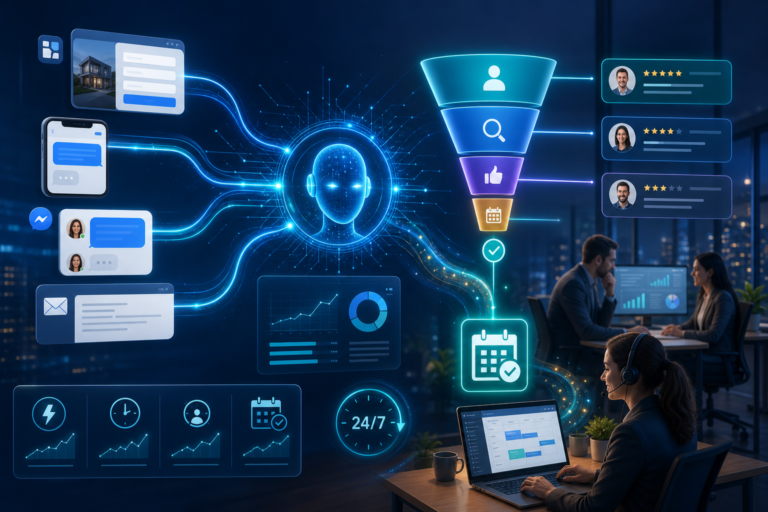
AI lead response automation operates through intelligent communication workflows that connect to your existing lead sources. When a potential customer submits an inquiry through your website, social media, or advertising campaigns, the system immediately detects the new lead and initiates engagement.
The automation platform analyzes the inquiry content to understand what the prospect needs. Using natural language processing, it identifies key information like service interest, urgency level, and qualification criteria. Based on this analysis, the system selects the most appropriate response from pre-configured conversation flows.
Responses go out instantly through the channel where the lead originated. If someone fills out a website form, they receive an immediate text message or email. If they message your Facebook page, the reply appears within seconds. This cross-channel capability ensures every lead gets a fast response regardless of how they contacted you.
The system continues the conversation by asking qualifying questions, providing relevant information, and guiding prospects toward booking appointments or requesting quotes. All of this happens automatically while maintaining a natural, personalized communication style that feels human.
Core Components of AI Lead Response Systems
Effective AI lead response automation platforms include several integrated components that work together to manage lead engagement. Understanding these elements helps you evaluate different solutions and implement them properly.
Lead detection monitors all your inbound channels continuously. The system connects to your website forms, landing pages, social media accounts, advertising platforms, and other lead sources. When new inquiries arrive, detection triggers happen instantly without any manual checking or notification delays.
Intent recognition analyzes what prospects are actually asking for. The AI reads inquiry text, identifies keywords and phrases, and determines what service or information the lead needs. This understanding allows the system to provide relevant responses instead of generic messages.
Response generation creates personalized replies based on the specific inquiry and your business information. Rather than sending identical messages to everyone, the system adapts its communication to match what each prospect asked about. This personalization increases engagement and makes automated responses feel more authentic.
Conversation management handles multi-turn interactions where leads ask follow-up questions or need additional information. The AI maintains context throughout the conversation, remembers what was already discussed, and builds on previous exchanges naturally.
Qualification workflows gather important information about each lead through strategic questions. The system identifies which prospects match your ideal customer profile, have genuine buying intent, and are ready to move forward. This qualification happens during the initial conversation without requiring separate sales team involvement.
Appointment scheduling integration allows qualified leads to book calls or meetings directly within the automated conversation. The AI presents available time slots, handles booking confirmations, and sends calendar invitations without any manual coordination.
Speed-to-Lead and Why It Matters
Speed-to-lead refers to how quickly your business responds after someone expresses interest. Research consistently shows that response time directly impacts conversion rates, with the first few minutes being absolutely critical.
Leads who receive responses within one minute are seven times more likely to have meaningful conversations with your sales team compared to those contacted even two minutes later. After five minutes, the likelihood of qualifying a lead drops by 80%. These statistics reveal why manual response processes put you at a severe disadvantage.
Consumers today expect immediate responses. When someone submits an inquiry, they are actively looking for solutions right now. They likely contacted multiple businesses at the same time. Whoever responds first typically wins the opportunity. If your competitors use automated lead response while you rely on manual follow-up, you will consistently lose prospects before ever getting a chance to compete.
Beyond winning more opportunities, fast responses also improve lead quality perception. When prospects get instant engagement, they view your business as more professional, organized, and customer-focused. This positive first impression carries through the entire sales process and makes closing easier.
AI lead response automation eliminates the speed-to-lead problem completely. Every inquiry receives engagement within seconds, regardless of when it arrives. Nights, weekends, holidays, and busy periods no longer create response delays. Your business maintains consistent instant engagement 24/7 without increasing labor costs.
Key Benefits for Service Businesses
Service-based companies see particularly strong results from AI lead response automation because of how their sales processes work. Unlike product purchases that happen through shopping carts, service sales require consultation, qualification, and relationship building. Automation enhances these processes rather than replacing them.
Increased conversion rates represent the most immediate benefit. By engaging every lead instantly and keeping prospects engaged through automated conversations, you convert more inquiries into booked appointments and closed sales. Businesses typically see conversion improvements between 25% and 40% after implementing response automation.
Reduced lead leakage stops prospects from falling through the cracks. Manual follow-up systems always miss some leads due to human error, workload, or timing issues. Automation ensures every single inquiry gets immediate attention and proper follow-up regardless of volume or circumstances.
Improved team efficiency lets your sales staff focus on high-value activities. Instead of spending time on initial outreach, answering basic questions, and chasing unresponsive leads, your team works with pre-qualified prospects ready for detailed conversations. This shift dramatically improves productivity and job satisfaction.
Better lead qualification happens earlier in the process through automated questioning. By the time a lead reaches your sales team, you already know their needs, budget, timeline, and fit. This information allows for more effective sales conversations and eliminates time wasted on unqualified prospects.
Consistent customer experience becomes automatic. Every lead receives the same high-quality engagement regardless of when they inquire or which team member would normally handle them. This consistency strengthens your brand and eliminates the variability that comes with different communication styles.
Scalability without proportional cost increases allows you to handle more leads without hiring more staff. As your marketing generates higher inquiry volumes, the automation system processes them all without degrading response times or overwhelming your team.
Common Use Cases Across Industries
Different types of service businesses implement AI lead response automation in ways that match their specific sales processes and customer expectations. Understanding these applications helps you see how the technology fits your operation.
Home service contractors including roofing companies, HVAC businesses, and plumbing services use automation to handle quote requests. When homeowners submit service inquiries, the AI immediately confirms receipt, asks qualifying questions about the property and issue, and schedules on-site assessment appointments. This instant engagement captures leads before they contact competitors.
Real estate professionals automate responses to property inquiries across listings. When potential buyers or renters ask about specific properties, the system provides detailed information, answers common questions, and offers showing appointments. The automation qualifies prospect budgets and timelines before involving agents in direct conversation.
Medical and dental practices use automated responses to handle appointment requests outside office hours. When patients contact the practice through websites or social media, the AI provides available appointment slots, collects necessary patient information, and confirms bookings. This removes the phone tag that typically frustrates patients seeking care.
Legal services firms automate initial consultations for potential clients. The system gathers case details, determines practice area fit, and schedules attorney consultations. This process qualifies leads based on case type and viability before consuming attorney time.
Solar installation companies engage homeowners interested in solar systems. The automation qualifies property characteristics, utility costs, and installation interest level. Qualified leads receive appointment bookings for site assessments while unqualified inquiries get educational content without wasting sales team resources.
Automotive service centers and dealerships respond to service appointment requests and vehicle inquiries automatically. The system handles routine scheduling for maintenance while flagging complex repairs for service advisor attention. This mixed approach maintains efficiency without sacrificing service quality.
Implementation Considerations
Successfully deploying AI lead response automation requires thoughtful planning around several key factors. The technology works best when properly configured to match your specific business needs.
Channel integration determines which lead sources connect to your automation system. Most businesses need connections to website forms, landing pages, Facebook and Instagram messaging, Google Business Profile messages, and SMS. Comprehensive integration ensures no inquiries get missed regardless of how prospects contact you.
Conversation design shapes how your automation communicates with leads. You need to define response templates, qualification questions, and conversation flows that align with your brand voice and sales process. Well-designed conversations feel natural and helpful rather than robotic or pushy.
Qualification criteria help the system identify which leads match your ideal customer profile. You define the characteristics, budget ranges, service needs, and timelines that indicate good fit. The automation uses this criteria to prioritize leads and route them appropriately.
Calendar integration connects your scheduling system to the automation platform. This allows leads to book appointments directly through automated conversations. Integration should sync with your team calendars in real-time to prevent double-bookings.
CRM connection ensures lead information flows into your customer relationship management system automatically. Every conversation, qualification data point, and appointment booking should sync to your CRM without manual data entry. This integration maintains clean records and enables proper follow-up.
Team training prepares your staff to work with the automation system effectively. Your sales team needs to understand how leads are qualified, what information is already gathered, and how to pick up conversations smoothly. Proper training maximizes the value of automated lead engagement.
AI Lead Response vs Traditional Methods
Comparing automated lead response to traditional manual approaches highlights the operational advantages that drive adoption across service businesses.
Response timing represents the most obvious difference. Manual methods rely on team members checking email, voicemail, or CRM notifications and then responding. Even well-trained teams rarely respond within the critical first five minutes. Nights and weekends create unavoidable delays. AI systems respond within seconds every time, all the time.
Consistency varies dramatically between approaches. Manual responses depend on individual team member communication skills, mood, workload, and training. Quality fluctuates. Automated systems deliver identical high-quality engagement to every lead without variation.
Scalability limits affect manual operations quickly. When lead volume increases, response times degrade unless you hire more staff. Automation handles 10 leads or 1,000 leads with the same speed and quality without additional cost.
Qualification completeness improves with automation. Human responders often forget to ask key qualifying questions or skip them when busy. Automated workflows ask every important question every time, building complete prospect profiles.
Data capture reliability increases through automation. Manual processes lose information when team members forget to update the CRM or take incomplete notes. Automated systems capture every conversation detail and sync it perfectly to your database.
Cost structure shifts from variable to fixed. Manual response requires ongoing labor costs that scale with volume. Automation platforms typically charge fixed monthly fees regardless of lead volume, creating more predictable economics.
Integration with Sales Workflows
AI lead response automation works best when properly connected to your broader sales process rather than operating as a standalone tool. Strategic integration ensures smooth handoffs and maintains positive customer experience.
The automation handles initial engagement and qualification, then routes qualified leads to your sales team at the right moment. This handoff should happen when the prospect is ready for detailed consultation, has provided all necessary qualifying information, and expects human contact. Well-timed transitions feel natural rather than jarring.
Your sales team receives qualified leads with complete context. Every conversation the AI had with the prospect, all qualifying information gathered, and any appointments booked appear in your CRM before the sales call happens. This preparation allows your team to start conversations at a more advanced stage.
Follow-up automation continues after initial contact. If a prospect books an appointment, the system sends confirmation and reminder messages automatically. If someone shows interest but does not book immediately, AI follow-up automation continues engagement until they are ready to move forward.
Multi-channel coordination maintains consistent communication across platforms. Whether a prospect initially contacted you through Instagram, your website, or SMS, the system tracks all subsequent interactions across channels. This prevents duplicate outreach and maintains conversation continuity.
Performance tracking monitors how well your lead response automation performs. You should review metrics like response times, engagement rates, qualification completion, and conversion rates regularly. This data helps you refine conversation flows and improve results over time.
Measuring Success and ROI
Quantifying the impact of AI lead response automation helps justify the investment and identify improvement opportunities. Several key metrics reveal how well the system performs.
Response time tracking shows how quickly the automation engages new leads. You should measure average response time and the percentage of leads contacted within one minute. These metrics verify that your speed-to-lead problem is actually solved.
Engagement rate measures how many leads respond to your automated messages. High engagement rates indicate that your conversation design feels natural and relevant. Low rates suggest messages need refinement to better match prospect expectations.
Qualification completion tracks how many leads provide all necessary information through automated conversations. Complete qualification enables better sales team preparation and more effective consultations.
Appointment booking rate shows what percentage of qualified leads schedule meetings through the automation. This metric directly impacts sales pipeline and reveals whether your scheduling integration works smoothly.
Conversion rate comparison measures how prospects engaged through automation convert compared to manual methods. Most businesses see 25% to 40% conversion improvements, but your specific results depend on your previous processes and implementation quality.
Cost per qualified lead calculation divides your automation platform cost by the number of qualified leads generated. This metric helps compare automation to other lead generation investments and alternative response methods.
Revenue attribution connects closed sales back to automated lead engagement. Tracking which customers first interacted with your AI response system shows the direct revenue impact and calculates true ROI.
Choosing an AI Lead Response Platform
Selecting the right automation solution requires evaluating several factors that affect both performance and operational fit. Not all platforms deliver the same capabilities or serve the same business types effectively.
Industry specialization matters because different businesses have different needs. Platforms built specifically for service businesses understand appointment booking, qualification workflows, and consultation scheduling better than generic chatbot tools. Look for solutions that already serve companies similar to yours.
Channel coverage determines which lead sources you can automate. Verify that any platform you consider integrates with all your important channels including website forms, social media messaging, SMS, and any industry-specific lead sources you use.
Conversation intelligence separates basic chatbots from true AI systems. Advanced platforms understand context, recognize intent, and maintain natural multi-turn conversations. Simple rule-based chatbots provide limited value and frustrate prospects.
Customization flexibility allows you to design conversations that match your brand and sales process. You should be able to customize message content, qualification questions, and conversation flows without requiring developer assistance.
Integration ecosystem includes connections to your existing tools like CRM systems, calendar platforms, and marketing software. Native integrations work more reliably than generic webhooks or API connections.
Support and training resources help your team implement and optimize the platform. Look for providers offering implementation assistance, training materials, and responsive technical support.
Pricing structure should align with your business model and lead volume. Some platforms charge per conversation or per lead, while others offer flat monthly fees. Consider which model creates more predictable costs for your situation.
GetDMFlow delivers purpose-built AI lead engagement specifically designed for service businesses. The platform combines instant lead response, intelligent qualification, automated appointment booking, and seamless CRM integration in a complete solution.
Common Implementation Mistakes to Avoid
Businesses new to AI lead response automation often make predictable mistakes that reduce effectiveness. Awareness of these issues helps you implement more successfully.
Over-automation pushes too much of the sales process to AI when human involvement would be better. While automation excels at initial engagement and qualification, complex questions and high-value discussions still benefit from personal attention. Find the right balance for your business.
Poor conversation design creates robotic, unnatural interactions that frustrate prospects. Your automated messages should sound like helpful team members, not corporate scripts. Use conversational language, ask one question at a time, and show personality.
Insufficient testing before launch leads to conversation flows that confuse prospects or miss important qualifying questions. Test your automation thoroughly with various inquiry types and edge cases before directing real leads through it.
Ignoring channel preferences frustrates prospects who want to communicate through their preferred platform. If someone messages you on Instagram, respond there rather than forcing them to text or email. Multi-channel capability prevents this friction.
Neglecting ongoing optimization treats automation as a set-it-and-forget-it tool. Regular review of conversation performance, engagement rates, and prospect feedback reveals improvement opportunities. Plan to refine your automation continuously.
Lack of team coordination creates confusion when leads transition from automation to human contact. Your sales team needs clear protocols for taking over automated conversations and context about what the AI already discussed.
Privacy and Compliance Considerations
Automated communication systems must handle customer data responsibly and comply with relevant regulations. Privacy and compliance requirements affect how you implement lead response automation.
Data protection laws like GDPR, CCPA, and other regional regulations govern how you collect, store, and use prospect information. Your automation platform should include features that support compliance including data retention controls, deletion capabilities, and consent management.
Communication regulations such as TCPA in the United States require consent before sending automated text messages. Make sure your lead capture forms properly obtain this consent and that your automation respects opt-out requests immediately.
Transparency about automation builds trust with prospects. While your AI should communicate naturally, some regions require disclosure that customers are interacting with automated systems. Balance legal requirements with conversation flow.
Data security protects sensitive customer information collected through automated conversations. Verify that your automation platform encrypts data, maintains secure infrastructure, and follows security best practices.
Record keeping requirements in certain industries mandate retention of customer communications. Your automation system should archive all conversations and make them accessible for compliance audits if needed.
Future Trends in Lead Response Automation
AI lead response technology continues evolving rapidly, with several trends shaping how businesses will engage prospects in the coming years.
Voice automation integration will allow AI systems to handle phone inquiries with the same intelligence currently applied to text-based communication. Prospects calling your business will interact with AI that understands speech, answers questions, and books appointments verbally.
Predictive lead scoring will analyze inquiry patterns to identify which leads are most likely to convert before qualification even completes. This allows sales teams to prioritize their attention on the highest-value opportunities.
Sentiment analysis will enable automation to detect prospect emotions and adjust communication style accordingly. If someone seems frustrated or confused, the system will recognize this and modify its approach or escalate to human assistance.
Video message integration will add visual communication to automated workflows. AI systems will send personalized video responses to high-value leads, combining automation efficiency with the personal touch of video.
Deeper CRM intelligence will allow automation platforms to access customer history and tailor conversations based on previous interactions. Returning customers will receive different engagement than first-time inquiries.
FAQ
What is AI lead response automation?
AI lead response automation is technology that instantly engages and qualifies inbound leads using artificial intelligence without requiring human intervention. The system monitors lead sources, detects new inquiries, and responds within seconds through automated conversations.
How fast does AI lead response automation respond to leads?
AI lead response automation typically responds within 5 to 30 seconds of inquiry submission. This immediate engagement happens 24/7 across all connected channels regardless of time, day, or lead volume.
Does AI lead response automation work for service businesses?
Yes, AI lead response automation works extremely well for service businesses including contractors, real estate professionals, medical practices, legal services, and local service providers. The technology handles appointment booking, qualification, and initial engagement that service sales require.
How much does AI lead response automation cost?
AI lead response automation platforms typically charge between $200 and $1,000 per month depending on features, lead volume, and channel integrations. This fixed cost usually replaces variable labor costs associated with manual lead response.
Will prospects know they are talking to AI?
Modern AI lead response systems communicate naturally enough that many prospects do not immediately recognize automation. However, transparency about AI usage builds trust, and systems should disclose automation when asked or when legally required.
Can AI lead response automation integrate with my CRM?
Most AI lead response automation platforms integrate with popular CRM systems including Salesforce, HubSpot, Pipedrive, and industry-specific solutions. Integration ensures lead data and conversation history sync automatically without manual entry.
What happens if a lead asks something the AI cannot answer?
Quality AI lead response systems recognize when questions exceed their capabilities and escalate to human team members smoothly. The automation notifies your team and provides full conversation context for seamless handoff.
How long does it take to implement AI lead response automation?
Basic AI lead response automation implementation typically takes one to two weeks including channel integration, conversation design, testing, and team training. More complex implementations with multiple integrations may require four to six weeks.
Does AI lead response automation replace sales teams?
No, AI lead response automation enhances sales teams rather than replacing them. The technology handles initial engagement and qualification so sales professionals can focus on consultations, relationship building, and closing with pre-qualified prospects.
What channels does AI lead response automation work with?
AI lead response automation typically works with website forms, landing pages, Facebook and Instagram messaging, SMS, Google Business Profile messages, and email. Comprehensive platforms support multiple channels simultaneously.
Start Responding to Leads Instantly
AI lead response automation transforms how service businesses capture and convert opportunities by eliminating response delays and engaging every prospect immediately. The technology delivers measurable improvements in conversion rates, team efficiency, and customer experience while reducing the operational burden of manual follow-up.
Implementing speed-to-lead automation positions your business to win more opportunities against competitors still relying on manual response methods. Every inquiry receives instant attention, proper qualification, and smooth progression through your sales funnel without requiring additional staff.
GetDMFlow provides purpose-built AI sales automation for service businesses ready to modernize their lead engagement process. The platform combines intelligent response automation, qualification workflows, appointment booking, and CRM integration in a complete solution designed specifically for how service businesses operate.
See how AI lead response automation can increase your conversion rates and reduce missed opportunities. Schedule a demo to explore how GetDMFlow fits your specific business needs and sales process.
