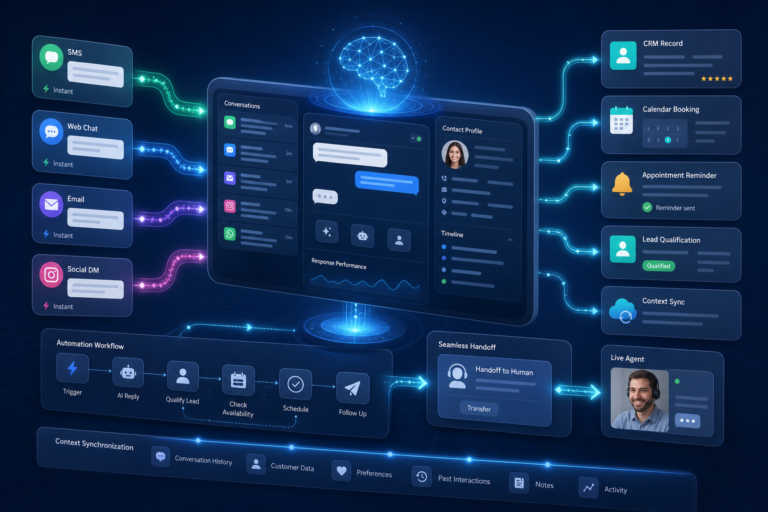

AI customer communication automation uses intelligent software to manage, respond to, and optimize business conversations across multiple channels without manual intervention. This technology enables service businesses to maintain consistent customer engagement, respond instantly to inquiries, and scale communication workflows while preserving quality and personalization. Modern AI customer communication automation platforms function as operational infrastructure that orchestrates messaging sequences, qualifies leads, books appointments, and maintains conversation context across SMS, web chat, email, and social channels.
Businesses implementing automated communication infrastructure typically see response times drop from hours to seconds, engagement rates increase by 40-60%, and operational costs decrease as teams focus on high-value interactions rather than repetitive messaging tasks. The technology has evolved from simple auto-responders to sophisticated systems that understand intent, maintain conversational context, and execute complex workflows based on customer behavior and business rules.
How AI Customer Communication Automation Works
AI messaging automation systems operate through three core components working together. The first component involves intelligent message processing, where natural language understanding algorithms analyze incoming customer messages to identify intent, extract key information, and determine appropriate responses. This processing happens in milliseconds, enabling real-time engagement that feels natural to customers.
The second component consists of workflow orchestration engines that execute predefined communication sequences based on triggers, customer actions, and business logic. These engines manage multi-step conversations, handle conditional branching, and coordinate activities across different channels. When a customer inquiry arrives, the system evaluates context, checks availability, accesses customer history, and initiates the most appropriate response path.
The third component includes integration layers that connect communication channels to business systems like CRMs, calendars, payment processors, and databases. This integration ensures conversations remain synchronized across platforms and that customer data flows seamlessly between systems. GetDMFlow exemplifies this architecture by connecting messaging automation to appointment scheduling, lead management, and follow-up workflows within a unified platform.
Core Functions of Automated Communication Systems
Automated customer communication platforms handle several critical business functions simultaneously. Instant inquiry response represents the most immediate value, with systems acknowledging customer messages within seconds regardless of time or day. This immediate engagement prevents lead leakage that occurs when prospects move to competitors during wait times.
Qualification workflows filter incoming inquiries by asking relevant questions, gathering necessary information, and routing qualified prospects to appropriate team members or next steps. This automated triage ensures sales teams spend time with ready-to-buy customers rather than unqualified inquiries. The qualification process can include budget confirmation, service need verification, timeline assessment, and decision-maker identification.
Appointment coordination automation eliminates scheduling friction by presenting available times, confirming bookings, sending reminders, and handling rescheduling requests without human involvement. Customers book appointments at their convenience while businesses maintain full calendar control and avoid double-bookings or scheduling conflicts.
Follow-up sequence execution keeps prospects engaged through scheduled touchpoints that deliver value, answer common questions, and move customers through buying journeys. These sequences adapt based on customer responses, maintaining relevance without feeling robotic or impersonal.
Key Components of AI Communication Workflows
Effective AI communication workflows contain several essential elements that work together to create seamless customer experiences. Trigger mechanisms initiate conversations based on specific events like form submissions, website visits, missed calls, or time-based schedules. These triggers ensure communication happens at optimal moments when customer interest peaks.
Message templates provide structured frameworks for responses while allowing dynamic personalization through variable insertion. Well-designed templates maintain brand voice consistency across thousands of conversations while adapting content to individual customer contexts. Templates should cover common scenarios including initial inquiries, appointment confirmations, follow-up messages, and re-engagement campaigns.
Conditional logic enables workflows to branch based on customer responses, behaviors, or attributes. If a customer indicates budget constraints, the workflow might present financing options. If they show urgency, the system prioritizes immediate appointment availability. This conditional branching creates personalized experiences at scale.
Escalation protocols determine when and how conversations transfer from automated systems to human team members. Clear escalation rules prevent customer frustration while maximizing automation efficiency. Common escalation triggers include complex questions, negative sentiment, high-value opportunities, or explicit customer requests for human assistance.
Benefits for Service-Based Businesses
Service businesses gain substantial operational advantages from implementing AI business messaging systems. Response speed improvements directly impact conversion rates, with studies showing that businesses responding within five minutes are 100 times more likely to connect with leads than those waiting 30 minutes. Automated systems eliminate response delays entirely, engaging every inquiry instantly regardless of volume or timing.
Capacity scaling becomes effortless as automated systems handle unlimited simultaneous conversations without additional staffing costs. During peak inquiry periods, marketing campaigns, or seasonal surges, businesses maintain consistent service quality without overwhelming team members. This scalability enables growth without proportional increases in communication overhead.
Consistency across customer interactions improves as automated systems deliver brand-aligned messaging every time. Human teams naturally vary in response quality, tone, and information accuracy based on mood, experience, and workload. Automation ensures every customer receives complete, accurate, and professionally crafted communication that reflects business standards.
Operational efficiency gains materialize as team members redirect time from repetitive messaging tasks to high-value activities like complex problem-solving, relationship building, and strategic work. Businesses typically report 60-70% reductions in time spent on routine communication after implementing intelligent messaging systems.
Multi-Channel Communication Synchronization
Modern customers expect seamless experiences across every channel they use to contact businesses. AI customer engagement platforms synchronize conversations across SMS, web chat, email, social media messaging, and phone channels, maintaining unified customer context regardless of communication method. This synchronization prevents frustrating situations where customers must repeat information when switching channels.
Channel preferences vary by customer demographics and context. Younger customers often prefer SMS or social messaging, while professional service inquiries might arrive via email or website forms. Automated communication infrastructure adapts to customer channel preferences while maintaining consistent conversation threads across all touchpoints.
Context preservation across channels enables customers to start conversations on websites, continue via SMS, and complete bookings through email without losing conversation history or having to re-explain needs. This continuity creates frictionless experiences that improve satisfaction and conversion rates.
GetDMFlow specializes in multi-channel synchronization, ensuring businesses never miss opportunities due to channel fragmentation or communication silos. The platform maintains complete conversation histories accessible to both automated systems and human team members across every customer touchpoint.
Integration With Business Systems
Automated communication platforms deliver maximum value when integrated with existing business systems. CRM integration ensures customer data synchronizes bidirectionally, with conversation insights flowing into customer records and CRM data informing communication personalization. This integration creates single sources of truth for customer information across organizations.
Calendar system connections enable real-time appointment booking with automatic availability checking, conflict prevention, and confirmation delivery. Integration with scheduling platforms like Google Calendar, Outlook, or specialized booking systems ensures automated appointment coordination reflects actual team availability.
Payment processor integration allows businesses to collect deposits, process payments, or send invoices directly within messaging workflows. This capability shortens sales cycles by removing friction between commitment and payment completion.
Marketing automation platform connections ensure communication workflows align with broader marketing campaigns, with trigger synchronization and performance data sharing between systems. This integration creates cohesive customer journeys spanning marketing, sales, and service touchpoints.
Setting Up Effective Communication Automation
Implementing AI messaging automation requires strategic planning and execution. The process begins with conversation mapping, where businesses document common customer inquiries, typical response patterns, and desired outcomes for different interaction types. This mapping identifies automation opportunities and defines workflow requirements.
Message library development follows, creating template collections that address identified conversation scenarios while maintaining brand voice and providing necessary information. Effective templates balance structure with personalization, include clear calls-to-action, and guide customers toward next steps.
Workflow configuration translates conversation maps into automated sequences with appropriate triggers, conditional logic, and escalation rules. This configuration requires understanding customer behavior patterns, typical objection points, and optimal engagement timing.
Testing and refinement ensure workflows function correctly before full deployment. Businesses should test various scenarios, edge cases, and customer response patterns to identify issues and optimize performance. Initial deployment often focuses on high-volume, low-complexity interactions before expanding to more sophisticated use cases.
Common Use Cases and Applications
Lead response automation represents the most common application, with systems immediately acknowledging new inquiries, qualifying interest, and scheduling consultations. This automation prevents the lead leakage that occurs when businesses fail to respond quickly to inbound opportunities.
Appointment reminder sequences reduce no-show rates by sending timely reminders via customers’ preferred channels. Automated reminders typically include appointment details, preparation instructions, and easy rescheduling options. Businesses implementing reminder automation commonly see no-show rates drop by 30-50%.
Customer onboarding workflows guide new customers through setup processes, deliver welcome information, and ensure smooth service initiation. Automated onboarding sequences maintain engagement during critical early relationship stages while reducing support burden on team members.
Re-engagement campaigns automatically reach out to inactive customers or stalled prospects with relevant offers, helpful information, or check-in messages. These campaigns recover revenue from dormant relationships without requiring manual outreach coordination.
Best Practices for Implementation
Successful implementation of automated customer communication requires adherence to several key principles. Start with high-volume, repetitive interactions rather than attempting to automate complex scenarios immediately. This approach delivers quick wins while building team confidence and system understanding.
Maintain clear brand voice throughout automated messages by developing comprehensive style guidelines and reviewing templates for consistency. Automated communication should feel authentically connected to brand identity rather than generic or robotic.
Implement gradual escalation protocols that move customers to human assistance smoothly when automation reaches its limits. Clear escalation triggers and seamless handoff processes prevent customer frustration while maximizing automation efficiency.
Monitor performance metrics continuously, including response rates, conversion rates, escalation frequency, and customer satisfaction scores. These metrics identify optimization opportunities and ensure automation delivers expected business results.
Measuring Communication Automation Success
Effective measurement requires tracking several key performance indicators. Response time metrics show how quickly automated systems engage inquiries compared to previous manual processes. Most businesses see response times improve from hours or minutes to seconds after implementing automation.
Engagement rates measure what percentage of customers interact with automated messages, provide requested information, or complete desired actions. Strong engagement rates indicate messaging resonates with customers and workflows function effectively.
Conversion metrics track how automation impacts business outcomes like appointment booking rates, qualified lead percentages, or sales completion rates. These metrics demonstrate automation’s bottom-line impact beyond operational efficiency.
Customer satisfaction scores reveal whether automated communication meets customer expectations and maintains service quality. Satisfaction measurements should specifically assess automated interaction quality rather than overall business satisfaction.
Security and Compliance Considerations
Businesses implementing AI business messaging systems must address important security and compliance requirements. Data protection protocols ensure customer information remains secure throughout communication workflows, with encryption, access controls, and secure storage practices protecting sensitive data.
Compliance with regulations like GDPR, CCPA, TCPA, and industry-specific requirements shapes communication practices, consent management, and data handling procedures. Automated systems should include built-in compliance features like opt-out handling, consent tracking, and data retention controls.
Audit trails documenting all automated communications provide accountability and enable compliance verification. Complete conversation histories with timestamps, delivery confirmations, and response records support regulatory requirements and business oversight.
GetDMFlow incorporates enterprise-grade security measures including data encryption, compliance tools, and comprehensive audit capabilities to ensure businesses meet regulatory obligations while automating communication.
Choosing the Right Automation Platform
Selecting appropriate technology requires evaluating several critical factors. Integration capabilities determine how well platforms connect with existing business systems like CRMs, calendars, and marketing tools. Robust integration ecosystems enable comprehensive automation across business operations.
Customization flexibility allows businesses to tailor workflows, messages, and logic to specific needs rather than forcing processes into rigid templates. Platforms offering visual workflow builders, custom field support, and flexible logic enable precise business alignment.
Scalability considerations ensure platforms handle growth in conversation volume, workflow complexity, and user numbers without performance degradation or cost explosions. Businesses should evaluate pricing models, technical infrastructure, and capacity limits.
Support and training resources impact implementation success and ongoing optimization. Platforms providing comprehensive documentation, responsive support teams, and educational resources enable faster value realization and continued improvement.
AI Customer Communication Automation vs Traditional Methods
Automated communication systems offer substantial advantages over traditional manual approaches. Speed represents the most obvious difference, with automation responding instantly while manual processes introduce delays ranging from minutes to days. These delays directly impact conversion rates and customer satisfaction.
Scalability limitations disappear with automation, as systems handle unlimited simultaneous conversations without additional staffing. Manual approaches require proportional headcount increases to manage growing communication volume, creating cost and management challenges.
Consistency improves dramatically as automated systems deliver uniform messaging quality across every interaction. Manual communication naturally varies based on individual team member skills, knowledge, mood, and availability, creating inconsistent customer experiences.
Cost efficiency favors automation for high-volume, repetitive interactions while humans remain superior for complex problem-solving and relationship development. Optimal approaches combine automated efficiency for routine tasks with human expertise for high-value interactions.
Future Trends in Communication Automation
The communication automation landscape continues evolving rapidly. Advanced natural language capabilities are enabling more sophisticated conversations with better intent understanding, context awareness, and natural response generation. Future systems will handle increasingly complex interactions that currently require human involvement.
Predictive engagement timing will leverage behavioral data and machine learning to initiate conversations at optimal moments when customers are most receptive. Rather than reacting to inquiries, systems will proactively engage customers with relevant information and offers.
Emotion and sentiment detection will enable automated systems to recognize customer frustration, confusion, or satisfaction and adapt communication approaches accordingly. This emotional intelligence will improve automated interaction quality and escalation decisions.
Voice integration will expand automation beyond text-based channels into phone conversations, with AI systems handling inbound calls, conducting qualification conversations, and scheduling appointments through natural voice interactions.
Common Implementation Challenges
Businesses implementing automated communication infrastructure frequently encounter specific obstacles. Technical integration complexity can slow deployment when connecting automation platforms to legacy systems, custom software, or complex technology stacks. Addressing integration challenges requires clear technical requirements, vendor support, and sometimes custom development work.
Change management resistance occurs when team members fear automation will replace jobs or reduce their value. Successful implementations emphasize how automation handles repetitive tasks while enabling teams to focus on higher-value work requiring human skills.
Message quality issues arise when templates feel robotic, fail to address customer needs, or lack appropriate personalization. Overcoming quality challenges requires investing time in template development, incorporating dynamic personalization, and continuously refining messaging based on customer feedback.
Workflow optimization requires ongoing attention as businesses learn which automation approaches work best for their specific customers and situations. Initial workflows rarely achieve optimal performance, requiring testing, measurement, and iterative refinement.
GetDMFlow’s Approach to Communication Automation
GetDMFlow delivers comprehensive AI customer communication automation specifically designed for service-based businesses. The platform combines instant inquiry response, intelligent qualification workflows, automated appointment booking, and multi-channel synchronization within unified infrastructure.
The system excels at speed-to-response, engaging every customer inquiry within seconds across SMS, web chat, and other channels. This instant engagement captures opportunities that competitors miss due to slower manual processes. Automated qualification workflows gather necessary information while routing high-value prospects to appropriate team members.
Seamless integration with existing business systems ensures communication automation works within current operational frameworks rather than requiring wholesale process changes. GetDMFlow connects to popular CRMs, calendar platforms, and business tools that service businesses already use.
The platform emphasizes ease of use with visual workflow builders, pre-built templates for common scenarios, and intuitive interfaces that enable non-technical users to create and modify automation. This accessibility ensures businesses can deploy and optimize communication automation without extensive technical resources.
Frequently Asked Questions
What is AI customer communication automation?
AI customer communication automation uses intelligent software to manage and respond to customer conversations across multiple channels without manual intervention. The technology handles inquiry response, qualification, appointment booking, follow-up sequences, and ongoing engagement while maintaining conversation context and personalization.
How does communication automation differ from chatbots?
Communication automation encompasses comprehensive workflow orchestration across channels, while chatbots typically focus on single-channel conversational interfaces. Automation platforms manage multi-step sequences, integrate with business systems, coordinate activities across channels, and handle complex workflows beyond simple question-answering.
What types of businesses benefit most from communication automation?
Service-based businesses with high inquiry volumes, appointment-based sales processes, and repetitive communication patterns gain the most value. This includes contractors, healthcare providers, professional services, home services, real estate, automotive businesses, and local service companies.
How quickly can businesses implement communication automation?
Basic automation workflows can launch within days, while comprehensive implementations typically require 2-4 weeks depending on integration requirements, workflow complexity, and customization needs. Platforms like GetDMFlow accelerate implementation through pre-built templates and guided setup processes.
Does automation replace human customer service teams?
Automation handles repetitive, high-volume interactions while human teams focus on complex situations, relationship building, and high-value opportunities. Most businesses maintain team sizes while redirecting human effort toward activities requiring empathy, creativity, and expertise that automation cannot replicate.
How much does AI communication automation cost?
Pricing varies significantly based on conversation volume, feature requirements, and integration needs. Most platforms offer tiered pricing starting around $100-500 monthly for small businesses, scaling to enterprise pricing for high-volume operations. Return on investment typically comes from increased conversions and operational efficiency rather than direct cost savings.
Can automated systems handle complex customer questions?
Modern systems handle routine questions effectively while escalating complex inquiries to human team members. Escalation protocols ensure customers receive appropriate assistance while automation manages what it can. The goal is optimal division of labor between automated and human support.
How do you maintain brand voice in automated messages?
Effective brand voice maintenance requires developing comprehensive style guidelines, creating carefully crafted templates, incorporating dynamic personalization, and regularly reviewing automated messages for consistency. Templates should reflect actual human communication patterns while maintaining professionalism.
What channels can communication automation cover?
Comprehensive platforms support SMS, web chat, email, social media messaging, and increasingly voice channels. Multi-channel capability ensures businesses engage customers through preferred communication methods while maintaining unified conversation context across all touchpoints.
How do you measure communication automation success?
Key metrics include response time, engagement rates, conversion rates, appointment booking rates, escalation frequency, and customer satisfaction scores. Businesses should establish baseline measurements before implementation and track improvements across these indicators to demonstrate automation value.
Start Automating Customer Communication Today
AI customer communication automation represents essential infrastructure for modern service businesses competing in fast-paced markets where response speed and consistency directly impact revenue. The technology has matured beyond experimental status to become operational necessity for businesses serious about converting inquiries, maintaining engagement, and scaling without proportional cost increases.
Implementing automated customer communication delivers measurable improvements in response times, conversion rates, and operational efficiency while enabling teams to focus on high-value activities that drive business growth. Businesses delaying automation adoption face increasing competitive disadvantages as customer expectations continue rising and manual processes fail to keep pace with inquiry volumes.
GetDMFlow provides the comprehensive communication automation infrastructure service businesses need to capture every opportunity, engage customers consistently, and scale operations efficiently. The platform combines intelligent messaging automation, multi-channel synchronization, and seamless business system integration within an accessible solution designed specifically for service business requirements.
Ready to transform how your business communicates with customers? Explore how GetDMFlow’s AI customer communication automation can improve response speed, increase conversions, and streamline operations for your service business.
