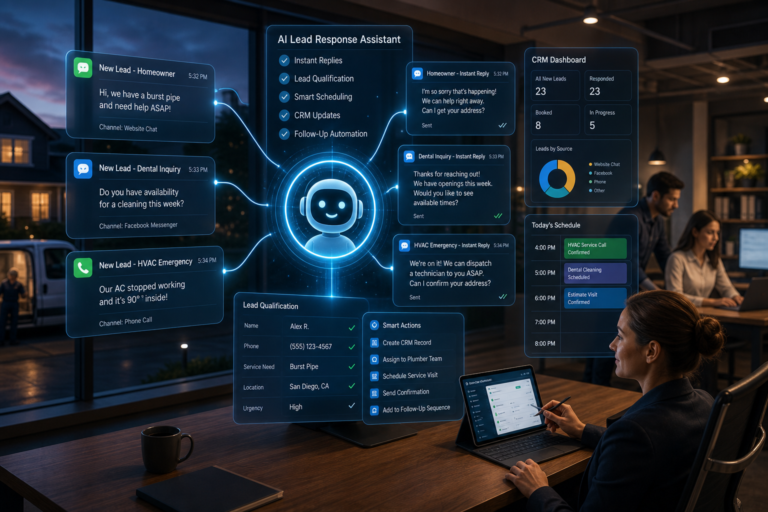

Service businesses lose potential customers every day because of slow lead response times. Research shows that 78% of customers choose the business that responds first. When a homeowner needs emergency HVAC repair or a patient searches for dental services, they expect immediate answers. Traditional manual processes create delays that cost businesses opportunities and revenue.
AI lead response automation solves this problem by engaging every lead instantly, qualifying prospects automatically, and booking appointments without human intervention. Service businesses now use intelligent automation platforms to respond faster, communicate better, and convert more leads into paying customers.
What is AI lead response automation software
AI lead response automation software uses artificial intelligence to immediately engage new leads through personalized, intelligent conversations across multiple channels. The technology responds to inquiries within seconds, qualifies prospects based on specific criteria, answers common questions, and schedules appointments without requiring staff involvement.
The software integrates with existing business systems including websites, phone lines, social media platforms, and CRM databases. When a potential customer submits a form, sends a text message, or initiates a conversation, the AI system instantly engages them with relevant information based on their specific needs and intent.
Unlike basic autoresponders that send generic messages, modern AI systems understand context, maintain natural conversations, and adapt responses based on customer replies. The technology handles multiple conversations simultaneously while maintaining personalization and accuracy across every interaction.
Why service businesses need faster lead response
Speed determines success in service business sales. Studies from Harvard Business Review found that businesses responding within five minutes are 100 times more likely to connect with leads compared to those waiting 30 minutes. The first responder typically wins the customer regardless of price or service quality differences.
Service businesses face unique timing challenges. A homeowner with a leaking roof needs immediate help and will call multiple contractors until someone answers. A patient experiencing dental pain wants the first available appointment. Real estate buyers touring properties expect instant information about listings that interest them.
Manual response processes create inevitable delays. Staff members handle other tasks, work outside business hours, or miss messages across different platforms. Every missed or delayed response represents lost revenue and wasted marketing investment. Businesses spend money generating leads but fail to capture them because of slow follow-up.
The competitive advantage of instant engagement
Businesses using AI lead response automation gain significant competitive advantages over competitors relying on manual processes. Instant engagement establishes immediate connection with prospects when their interest peaks. Early interaction builds trust and demonstrates reliability before competitors even respond.
Automation enables businesses to maintain consistent communication quality regardless of volume, time, or staff availability. Every lead receives the same professional, helpful response whether they inquire at 3 PM on Tuesday or 11 PM on Saturday. Consistency improves brand perception and customer experience throughout the sales process.
Faster response directly impacts conversion rates. Businesses implementing automated lead response systems report 40-60% increases in appointment booking rates and 25-35% improvements in overall lead conversion. The technology transforms lead generation investments into measurable business results by ensuring no opportunity goes unnoticed or unengaged.
Core features of effective AI lead response automation
Effective AI lead response automation platforms provide specific capabilities that directly impact business results. Understanding these features helps service businesses evaluate solutions and implement systems that deliver measurable improvements.
Instant multi-channel engagement
Modern customers communicate through diverse channels including website forms, text messages, social media, email, and phone calls. Effective automation systems monitor all channels simultaneously and respond instantly regardless of where the inquiry originates. This omnichannel approach ensures businesses never miss leads because they checked the wrong platform.
The best systems maintain conversation continuity across channels. If a customer starts a conversation via text and later calls, the AI recognizes the existing interaction and continues the dialogue without requiring repeated information. This seamless experience improves customer satisfaction and increases conversion likelihood.
Intelligent lead qualification
Not every inquiry represents an ideal customer. AI systems qualify leads by asking strategic questions that identify budget, timeline, location, project scope, and decision-making authority. The technology scores leads based on predefined criteria and routes high-value prospects to sales teams while providing information to others not yet ready to buy.
Qualification happens naturally within conversation flow rather than through rigid forms. The AI adapts questions based on responses, gathering necessary information while maintaining friendly, helpful dialogue. This approach improves data quality while creating positive customer experiences that build trust.
Automated appointment scheduling
Scheduling appointments consumes significant staff time and often involves multiple back-and-forth messages to find suitable times. AI appointment booking automation eliminates this friction by checking calendar availability, offering appropriate time slots, confirming appointments, and sending automated reminders.
The system handles scheduling complexities including different service durations, staff availability, location requirements, and booking rules. Customers receive immediate confirmation rather than waiting for manual scheduling. This instant gratification increases show rates and reduces last-minute cancellations.
Personalized customer communication
Effective AI systems deliver personalized responses based on customer context, business type, service needs, and previous interactions. A homeowner asking about roof replacement receives different information than someone inquiring about minor repairs. The system references specific services, local considerations, and relevant details that demonstrate understanding.
Personalization extends beyond simple name insertion. Advanced platforms analyze inquiry context, time of day, geographic location, and referral source to tailor conversations appropriately. This intelligent customization creates authentic interactions that feel human rather than automated.
Continuous follow-up automation
Most leads require multiple touchpoints before converting into customers. AI follow-up automation maintains engagement through scheduled messages that provide value, answer questions, share relevant information, and move prospects through the sales process.
Follow-up sequences adapt based on customer responses and actions. If a prospect clicks a pricing link, the system sends related information about payment options. If someone doesn’t respond to initial messages, the AI adjusts timing and approach. This intelligent persistence keeps businesses top-of-mind without annoying prospects.
How AI lead response automation works
Understanding the operational mechanics helps businesses implement automation effectively and set realistic expectations about capabilities and requirements.
Integration with existing business systems
AI lead response automation platforms connect with existing business infrastructure including websites, CRM systems, scheduling tools, phone systems, and marketing platforms. Modern solutions use APIs and webhooks to create seamless data flow between systems without requiring complex technical implementation.
Integration enables the AI to access necessary information including service offerings, pricing, availability, customer history, and business policies. This data access allows the system to provide accurate, helpful responses that reflect current business operations. Changes made in one system automatically update across the automation platform.
Natural language processing and understanding
AI systems use natural language processing to understand customer intent regardless of how questions are phrased. The technology recognizes variations in wording, handles spelling errors, interprets context, and responds appropriately to conversational language rather than requiring specific keywords or phrases.
This understanding enables natural dialogue flow. Customers ask questions as they would with human representatives. The AI provides relevant answers, asks clarifying questions when needed, and maintains context throughout multi-turn conversations. This natural interaction creates positive experiences that build trust and encourage engagement.
Machine learning and continuous improvement
Advanced platforms incorporate machine learning to improve performance over time. The system analyzes successful conversations, identifies patterns in customer behavior, learns which responses generate better outcomes, and refines its approach based on real-world results.
Businesses provide feedback on AI interactions, marking helpful responses and flagging issues. The platform uses this input to enhance accuracy and effectiveness. Over time, the AI becomes increasingly aligned with specific business needs, industry terminology, and customer preferences.
Human handoff and escalation
Effective automation includes intelligent human handoff capabilities. The AI recognizes situations requiring human attention including complex questions, upset customers, high-value opportunities, or scenarios outside its programming. The system seamlessly transfers conversations to appropriate team members with full context and conversation history.
This hybrid approach combines automation efficiency with human expertise. Routine interactions happen automatically while important conversations receive personal attention. Staff members focus on high-value activities rather than repetitive tasks, improving job satisfaction and business results.
Industry-specific applications for service businesses
Different service industries face unique lead response challenges and opportunities. AI automation adapts to specific industry needs while maintaining consistent core functionality.
Roofing companies
Roofing businesses handle high-value projects with urgent timing requirements. Homeowners often contact multiple contractors simultaneously after discovering roof damage. Roofing AI automation responds instantly with project assessment questions, provides rough timeline and pricing information, and schedules inspection appointments.
The AI qualifies leads by asking about damage type, roof age, home size, and insurance involvement. This information helps contractors prioritize emergency situations and allocate resources effectively. Automated follow-up maintains engagement throughout the inspection and proposal process.
HVAC contractors
HVAC businesses manage both emergency service calls and planned installation projects. AI systems differentiate between urgent repair needs and scheduled maintenance or replacement inquiries. HVAC AI automation triages requests appropriately, dispatches emergency services, and books maintenance appointments automatically.
The technology handles seasonal volume fluctuations by managing increased inquiries during extreme weather without requiring additional staff. Automated appointment reminders reduce no-shows for maintenance visits while follow-up sequences nurture leads interested in system replacements.
Dental practices
Dental offices balance patient care with administrative tasks including appointment scheduling, insurance verification, and inquiry management. Dentist AI automation handles new patient registration, answers common questions about services and insurance, and fills appointment cancellations automatically.
The AI qualifies patients by asking about specific dental concerns, insurance coverage, and appointment preferences. This information prepares staff for efficient visits while ensuring appropriate time allocation for different procedures. Automated reminders significantly reduce missed appointments.
Real estate professionals
Real estate agents manage numerous leads across different properties and transaction stages. Real estate AI automation engages prospects immediately with property information, answers questions about listings, and schedules showings automatically based on agent availability.
The system qualifies buyers by asking about price range, location preferences, property requirements, and financing status. This qualification helps agents focus on serious buyers while maintaining engagement with prospects in earlier research stages. Automated follow-up shares new listings matching stated preferences.
Med spas
Med spas offer diverse treatments with varying prices, requirements, and appointment durations. Med spa AI automation educates prospects about different services, answers questions about procedures and pricing, and books consultations or appointments based on treatment type.
The AI handles sensitive conversations professionally, asking appropriate questions about treatment goals and medical history while respecting privacy concerns. Automated follow-up nurtures leads through the consideration process with educational content and special offers.
Other service industries
AI lead response automation serves diverse service businesses including solar companies, automotive businesses, and law firms. Each industry benefits from instant response, automated qualification, efficient scheduling, and consistent follow-up adapted to specific business needs.
Key benefits of implementing AI lead response automation
Businesses implementing AI lead response automation experience measurable improvements across multiple performance metrics. Understanding these benefits helps justify investment and set implementation priorities.
Increased lead conversion rates
Businesses using automated lead response systems convert 30-50% more leads into customers compared to manual processes. Instant engagement captures interest at peak moments while intelligent qualification identifies serious prospects. Automated follow-up maintains relationships through the decision process rather than allowing leads to go cold.
Higher conversion rates directly impact revenue without requiring increased marketing spend. Businesses extract more value from existing lead generation efforts by ensuring every inquiry receives appropriate attention and nurturing. This efficiency improves return on marketing investment significantly.
Reduced response time from hours to seconds
Manual processes typically involve response delays ranging from several hours to multiple days depending on staff availability and workload. AI systems respond within seconds regardless of timing or volume. This dramatic speed improvement captures opportunities that competitors miss and demonstrates professionalism that builds customer confidence.
Instant response particularly benefits businesses in competitive markets where multiple providers serve similar customers. The first responder establishes relationship foundations that subsequent competitors struggle to overcome even with superior offerings or pricing.
24/7 availability without additional staff
Customers research and initiate contact outside traditional business hours. Studies show that 62% of service business inquiries happen after 5 PM or on weekends. Manual processes miss these opportunities or create frustrating delays. Automation provides consistent availability that matches customer behavior patterns.
Constant availability improves customer satisfaction by accommodating diverse schedules and urgent needs. Businesses capture evening and weekend leads that generate revenue without requiring night shifts or overtime pay. This scalability enables growth without proportional staffing increases.
Improved customer experience and satisfaction
Customers appreciate immediate responses, personalized interactions, and efficient processes. AI automation delivers consistent quality across every interaction while eliminating common frustrations including long wait times, unreturned messages, and scheduling difficulties.
Positive early experiences establish strong foundations for ongoing relationships. Customers satisfied with initial interactions become easier to convert, more likely to accept recommendations, and more willing to provide referrals. This satisfaction creates compound benefits throughout customer lifetime value.
Better resource allocation and efficiency
Automation handles repetitive tasks that consume significant staff time including answering common questions, qualifying leads, scheduling appointments, and sending follow-up messages. This efficiency allows team members to focus on high-value activities including closing sales, delivering services, and building customer relationships.
Businesses report 40-60% reductions in time spent on routine communication tasks after implementing automation. Staff members redirect this time toward activities that require human expertise and directly generate revenue. This reallocation improves both employee satisfaction and business profitability.
Consistent communication quality
Human performance varies based on experience, training, mood, and workload. AI systems deliver consistent quality across every interaction. Every customer receives accurate information, professional communication, and appropriate follow-up regardless of when they inquire or which team member would have handled the conversation manually.
Consistency protects brand reputation and ensures reliable customer experiences. Businesses avoid situations where one customer receives excellent service while another encounters poor communication. This reliability builds trust and positive word-of-mouth referrals.
Choosing the right AI lead response automation platform
Selecting appropriate automation technology significantly impacts implementation success and business results. Service businesses should evaluate platforms based on specific criteria aligned with operational needs and growth objectives.
Essential evaluation criteria
Effective platforms provide industry-specific customization, multi-channel support, CRM integration, appointment scheduling capabilities, intelligent routing, and detailed analytics. The technology should handle your specific business processes rather than requiring significant workflow changes to accommodate system limitations.
Ease of implementation and ongoing management matters considerably. Platforms requiring extensive technical expertise or constant maintenance create hidden costs and implementation delays. Look for solutions offering intuitive interfaces, clear documentation, and responsive support that enables quick deployment and easy adjustments.
Integration capabilities
The platform must integrate seamlessly with existing business systems including your CRM, scheduling software, payment processors, and marketing tools. Poor integration creates data silos, manual data entry requirements, and synchronization issues that reduce efficiency and accuracy.
Evaluate integration methods and available connectors. Platforms offering pre-built integrations with popular business software simplify implementation. API access enables custom integrations when necessary. Strong integration capabilities future-proof your investment by accommodating system changes and additions.
Customization and flexibility
Your business has unique processes, terminology, and customer expectations. Effective platforms allow customization of conversation flows, qualification criteria, scheduling rules, and automated responses. This flexibility ensures the AI accurately represents your brand and handles situations appropriately.
Customization should be accessible to non-technical users. Platforms requiring developer involvement for routine adjustments create bottlenecks and ongoing costs. Look for visual workflow builders and template systems that enable business users to make changes independently.
Reporting and analytics
Understanding automation performance enables continuous improvement and ROI measurement. Platforms should provide detailed analytics including response times, conversation completion rates, appointment booking rates, lead quality metrics, and conversion tracking.
Good reporting shows not just what happened but why. Look for platforms offering conversation transcripts, sentiment analysis, drop-off identification, and performance comparisons. This visibility enables data-driven optimization that improves results over time.
Security and compliance
Service businesses handle sensitive customer information including contact details, financial data, and personal situations. Automation platforms must provide enterprise-grade security, data encryption, access controls, and compliance with relevant regulations including privacy laws and industry-specific requirements.
Evaluate data handling practices, storage locations, backup procedures, and compliance certifications. Platforms should clearly explain how customer data is protected and provide tools for managing privacy preferences and data retention policies.
How GetDMFlow helps businesses automate lead response and conversion
GetDMFlow provides comprehensive AI sales automation designed specifically for service businesses. The Canadian platform helps companies capture, engage, qualify, and convert more leads through intelligent automation that works across multiple channels.
The system responds to inquiries within seconds regardless of source or timing. When potential customers submit website forms, send text messages, or initiate conversations, GetDMFlow engages them immediately with personalized, helpful responses. This instant engagement captures opportunities that competitors miss while demonstrating professionalism that builds trust.
GetDMFlow qualifies leads automatically by asking strategic questions that identify serious prospects. The platform assesses budget, timeline, project scope, and decision authority through natural conversations that feel helpful rather than interrogative. Qualified leads route to appropriate team members with complete context and conversation history.
AI customer communication automation maintains engagement through intelligent follow-up sequences adapted to customer responses and behaviors. The system shares relevant information, answers questions, addresses concerns, and moves prospects through the sales process without requiring constant staff attention.
Appointment scheduling happens automatically through integration with existing calendar systems. GetDMFlow checks availability, offers appropriate time slots based on service type and duration, confirms bookings, and sends automated reminders that reduce no-shows. Customers receive instant confirmation rather than waiting for manual scheduling.
The platform serves diverse service industries including roofing, HVAC, dental, real estate, med spas, solar, automotive, and law firms. Industry-specific customization ensures the AI understands relevant terminology, handles common scenarios appropriately, and provides information that matches customer expectations.
AI CRM automation creates seamless data flow between lead capture, customer communication, and business management systems. Information gathered during automated conversations automatically updates CRM records, triggers appropriate workflows, and provides visibility into lead status and engagement history.
Detailed analytics show exactly how automation impacts business results. GetDMFlow tracks response times, engagement rates, qualification metrics, appointment bookings, and conversion rates. This visibility enables continuous optimization and clear ROI measurement.
Businesses implementing GetDMFlow report significant improvements in lead response speed, appointment booking rates, and overall conversion efficiency. The platform transforms lead generation investments into measurable results by ensuring every opportunity receives immediate, professional attention.
Getting started with AI lead response automation
Implementing automation successfully requires strategic planning and systematic execution. Following proven implementation processes helps businesses achieve results quickly while avoiding common pitfalls.
Define clear objectives and success metrics
Start by identifying specific problems automation will solve and measurable outcomes that indicate success. Clear objectives might include reducing response time to under one minute, increasing appointment booking rates by 40%, or improving lead conversion by 25%. Specific metrics enable progress tracking and ROI calculation.
Involve team members who handle customer communication in objective setting. Their frontline experience identifies pain points, common scenarios, and opportunities automation should address. This involvement also builds buy-in that supports successful adoption.
Document current processes and customer journeys
Map existing lead response workflows including how inquiries arrive, who handles them, what information is gathered, how qualification happens, and how appointments are scheduled. This documentation identifies automation opportunities and ensures the new system handles necessary functions.
Analyze common customer questions, objections, and conversation patterns. This analysis informs AI training and conversation design. Understanding typical customer journeys ensures automation provides helpful, relevant information at appropriate times.
Configure and customize your automation platform
Set up conversation flows that match your business processes and customer expectations. Configure qualification questions, appointment scheduling rules, follow-up sequences, and routing logic. Customize responses to reflect your brand voice and include relevant business information.
Start with core scenarios that handle the majority of inquiries. Add complexity gradually based on real-world performance and identified needs. This iterative approach enables faster initial deployment and reduces overwhelming complexity during setup.
Test thoroughly before full deployment
Conduct extensive testing using realistic scenarios and diverse inquiry types. Verify that the AI provides accurate information, handles edge cases appropriately, and escalates to humans when necessary. Testing identifies issues before they affect customer experiences.
Involve multiple team members in testing to gather diverse perspectives. Sales representatives, customer service staff, and managers each notice different aspects of functionality and usability. Their feedback improves system effectiveness.
Train staff on the hybrid model
Even with automation, staff members play critical roles in handling escalations, closing high-value opportunities, and providing expertise for complex situations. Train team members on when the AI will engage them, how to access conversation history, and best practices for taking over automated conversations.
Help staff understand automation as a tool that enhances their effectiveness rather than a replacement for their roles. Emphasize how automation handles repetitive tasks so they can focus on activities requiring human expertise and relationship building.
Monitor performance and optimize continuously
Track key metrics including response times, engagement rates, qualification accuracy, appointment bookings, and conversion rates. Compare performance against baseline measurements and defined objectives. Regular monitoring identifies both successes to celebrate and opportunities for improvement.
Review conversation transcripts to understand how customers interact with the AI. Look for common questions the system handles poorly, frequent escalation triggers, and opportunities to improve response quality. Use these insights to refine conversation flows and train the AI more effectively.
Common challenges and solutions
Businesses implementing AI lead response automation encounter predictable challenges. Understanding these obstacles and proven solutions helps ensure successful deployment.
Maintaining brand voice and personality
Concern: Automated responses might sound robotic or fail to reflect brand personality.
Solution: Modern AI platforms allow extensive customization of tone, language, and personality. Invest time in crafting responses that sound like your team. Include brand-specific phrases, appropriate humor, and conversational elements that create authentic connections. Review and refine responses based on customer feedback.
Handling complex or unique situations
Concern: AI cannot handle every possible customer question or scenario.
Solution: Effective automation includes intelligent escalation to human team members for situations requiring expertise or personal attention. Configure clear escalation triggers and ensure smooth handoff processes. The goal is handling common scenarios automatically while involving humans for complex situations.
Integration with existing systems
Concern: Connecting automation platforms with current business systems might require technical expertise or create data synchronization issues.
Solution: Choose platforms offering pre-built integrations with popular business software. Platforms like GetDMFlow provide native connections with common CRM, scheduling, and communication tools. Work with platform support teams during implementation to ensure smooth integration setup.
Staff resistance to automation
Concern: Team members might view automation as threatening their jobs or undermining their expertise.
Solution: Frame automation as a tool that enhances staff effectiveness rather than replacement technology. Show how automation eliminates tedious tasks and allows focus on high-value activities. Involve team members in implementation planning and demonstrate how automation improves their daily work experience.
Measuring return on investment
Concern: Quantifying automation value and justifying ongoing investment can be challenging.
Solution: Establish baseline metrics before implementation including average response time, lead conversion rate, appointment booking rate, and staff time spent on routine tasks. Track these same metrics after deployment to demonstrate concrete improvements. Calculate time savings, increased revenue, and efficiency gains to show clear ROI.
Future trends in AI lead response automation
AI lead response automation continues evolving rapidly. Understanding emerging trends helps businesses plan for future capabilities and competitive dynamics.
Advanced personalization through predictive analytics
Next-generation systems will predict customer needs and preferences based on behavior patterns, demographic information, and historical data. This predictive capability enables proactive engagement with highly relevant information before customers explicitly ask questions.
Voice and video interaction capabilities
As voice AI technology improves, automation platforms will handle phone conversations with the same sophistication currently available through text-based interactions. Video capabilities will enable visual appointment consultations and property tours through automated systems.
Deeper integration with business intelligence
Future platforms will connect lead response automation more closely with business analytics and intelligence systems. This integration will enable real-time optimization of conversation flows, pricing strategies, and resource allocation based on comprehensive business data.
Enhanced emotional intelligence
Advanced natural language processing will better recognize customer emotions, stress levels, and satisfaction. Systems will adapt communication style based on detected emotional states, providing more empathetic responses and escalating appropriately when customers show frustration.
Industry-specific AI models
Instead of general-purpose platforms requiring extensive customization, specialized AI models trained on industry-specific conversations and terminology will provide superior out-of-box performance for service businesses in particular sectors.
Frequently asked questions
What is AI lead response automation software?
AI lead response automation software uses artificial intelligence to instantly engage new leads through personalized conversations across multiple channels. The technology qualifies prospects, answers questions, schedules appointments, and maintains follow-up automatically without requiring human involvement for routine interactions.
How quickly can AI respond to new leads?
AI systems respond to new leads within seconds of inquiry regardless of time, day, or volume. This instant engagement happens 24/7 across all channels including website forms, text messages, social media, and email.
Does AI replace human sales representatives?
No. Effective AI automation handles repetitive tasks and routine inquiries while escalating complex situations, high-value opportunities, and scenarios requiring human expertise to appropriate team members. The technology enhances sales team effectiveness rather than replacing people.
Which industries benefit most from AI lead response automation?
Service businesses with high inquiry volumes and time-sensitive customer needs benefit significantly. This includes roofing companies, HVAC contractors, dental practices, real estate professionals, med spas, solar companies, automotive businesses, and law firms.
How does AI qualify leads automatically?
AI systems qualify leads by asking strategic questions during natural conversations. The technology assesses budget, timeline, project scope, location, and decision authority based on customer responses. Qualified leads route to sales teams while others receive appropriate nurturing.
Can AI handle appointment scheduling?
Yes. AI appointment booking automation checks calendar availability, offers appropriate time slots, confirms bookings, and sends reminders automatically. The system handles scheduling rules, service durations, and staff availability without manual intervention.
What happens if the AI cannot answer a question?
When AI encounters situations outside its programming or knowledge, it smoothly escalates the conversation to human team members. Customers receive seamless handoff with full conversation context so they do not need to repeat information.
How long does implementation take?
Implementation timelines vary based on business complexity and customization requirements. Basic deployments often happen within 1-2 weeks while more complex implementations with extensive integrations might require 4-6 weeks. Platforms like GetDMFlow offer streamlined setup processes that minimize deployment time.
Is customer data secure with AI automation platforms?
Reputable platforms provide enterprise-grade security including data encryption, secure storage, access controls, and compliance with privacy regulations. Evaluate security practices and certifications when selecting platforms.
How much does AI lead response automation cost?
Pricing varies based on features, conversation volume, and business size. Most platforms offer tiered pricing starting around $200-500 monthly for basic plans. Enterprise solutions with advanced features and higher volumes range from $1,000-5,000+ monthly. GetDMFlow offers transparent pricing aligned with business needs.
Can I customize AI responses to match my brand?
Yes. Modern platforms allow extensive customization of conversation flows, response language, tone, and personality. Businesses configure responses that reflect their brand voice and communication style.
How do I measure automation ROI?
Track metrics including response time improvements, lead conversion rate increases, appointment booking rate growth, and staff time savings. Compare these against platform costs to calculate return on investment. Most businesses see positive ROI within 2-3 months.
Conclusion
AI lead response automation transforms how service businesses capture and convert opportunities. Instant engagement, intelligent qualification, automated scheduling, and consistent follow-up solve critical challenges that cause lost revenue and wasted marketing investment. Businesses implementing automation respond faster, communicate better, and convert more leads without requiring proportional staff increases.
The technology provides measurable benefits including 30-50% higher conversion rates, 24/7 availability, improved customer satisfaction, and significant time savings. Service businesses across industries from roofing and HVAC to dental and real estate use AI lead conversion automation to compete effectively and grow efficiently.
Success requires selecting appropriate platforms, implementing strategically, and optimizing continuously based on performance data. Businesses that embrace automation gain competitive advantages that compound over time as AI capabilities continue advancing.
GetDMFlow provides comprehensive AI sales automation built specifically for service businesses. The platform handles lead response, customer communication, appointment booking, and follow-up workflows across multiple channels. Industry-specific customization ensures the AI understands your business and serves your customers effectively.
Discover how GetDMFlow can help your business respond faster, engage better, and convert more leads. Book a demo to see the platform in action and discuss how AI automation fits your specific needs and growth objectives. Transform your lead response process from a competitive weakness into a sustainable advantage.
